
Name: Iris Kim
Class Year: 2026
Major: Linguistics
Minor: Chinese
Internship Organization: Swarthmore College
Internship Title: Research Assistant
Location: Philadelphia, PA
What’s happening at your internship? We would love to hear what kind of work you are doing!
Hi! I’m Iris Kim, a rising senior at Bryn Mawr majoring in linguistics. This summer, I interned at Swarthmore College under Professor Donna Jo Napoli, working on two of her ongoing projects: her nonprofit RISE and her academic research on sign language phonology. One of my favorite projects this summer was writing a Python program to help organize and store sign language data for future analysis. Sign language dictionaries rely on video and image content rather than text, which can make digital storage and research tricky. Using skills I learned through Bryn Mawr’s Computer Science department, I designed a tool that I hope will be useful to other linguists studying sign language.
Why did you apply for this internship?
I found the opportunity through the Tri-College Consortium’s linguistics email list—a resource that supports community and shares professional opportunities across the Tri-Co linguistics program. (Learn more about Bryn Mawr’s program here: https://www.brynmawr.edu/academics/majors-minors-and-concentrations/linguistics.) I applied hoping to get firsthand experience in applied linguistics research, since most of my experience thus far has been with theoretical linguistics. I wanted to help people, and learn what it looks like to help people from within academia.
Was this internship what you expected it to be?
Not really, but I don’t mind! At first, I thought my role would focus solely on producing bimodal video-books for RISE—videos that combine a written language with a sign language, created in partnership with deaf schools around the world. I was hired to help edit graphics and video materials. But on my first day, Donna Jo explained that RISE’s workflow depends on outreach cycles; sometimes multiple schools want to collaborate, and other times things are quieter. I worried that the summer might be slower than expected—but Donna Jo assured me there would always be meaningful work to do. And while we didn’t receive new partner requests this summer, I’ve been deeply involved in outreach efforts and have assisted in her academic research on sign language. This array of projects gave me a look into Donna Jo’s career, giving me more experience with the field as a whole than I had expected.
Can you talk about the skills you are learning and why they are important to you?
Over this summer, I have practiced the skills of computer programming, data analysis, and research– specifically in the area of designing studies. This internship has clarified for me where in these areas I am strong, and where I can seek more education in. But it also turned out to be more than a skills-building opportunity. I came in expecting rigid deadlines and clearly defined tasks. Instead, I found a flexible environment where creativity, problem-solving, and forward thinking were not only encouraged but expected. I have watched as Donna Jo made decisions about what steps to take in her work to best contribute to her academic field, help deaf children, and prepare RISE for future endeavors. She has given me room to ask questions, contribute ideas, and shape the direction of our work together. I look forward to applying this adaptive workflow in future endeavors.
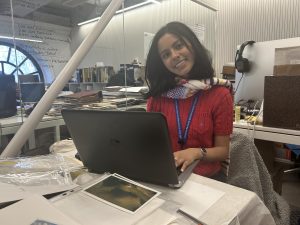
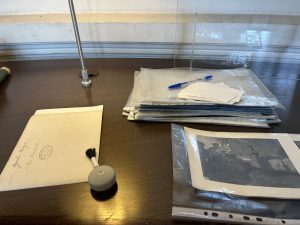 For the last few months, I have been doing work in the archives at the Museo Nacional de Bellas Artes (MNBA). The tasks I completed for the Centro de Documentación (CEDOC) Angélica Pérez Germain varied but all the work had a focus on preserving and promoting Chile’s contributions to the art world. Within the work one transferable skill I learned were the procedures to follow when handling documents and photos.
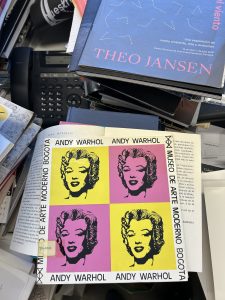 I discovered my internship opportunity through the partnership Bryn Mawr has with IES abroad. I was thrilled once I received my placement in Santiago because I had studied abroad the previous fall in Latin America through the study abroad office. I felt this was the right choice for me since I could continue to build upon skills and IES matches students to internships that aligns with their career interests which was an important deciding factor for my junior summer.
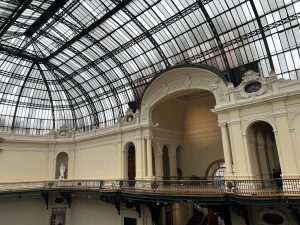 The most rewarding part of my summer internship was contributing to the archive. Due to the fact that the museum is the oldest in the Americas, the archive is vast and is in need of constant organizing. Throughout the summer the archive received various donations from Chilean artists who left their documents and personal archives to the museum. It was exciting and impactful to uncover history through the stories of artists, collectors, and institutions in connection to the museum. The team I worked with including students from local universities and departments in conjunction with the archive helped me understand the importance of Chilean history. One experience that was particularly valuable was the opening of the Sala Chile (Gallery) focused on the life and art of Chilean artist, Roberto Matta. The archive helped organize the exhibition and provided historic context to establish the permanent exhibition titled Historias de una Colección. I was able to attend the opening and hear from the various groups who collaborated on this project including the ministry of culture.


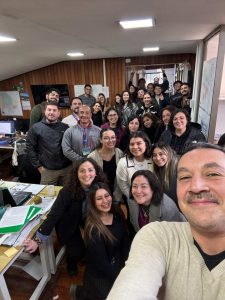 This summer, I was fortunate enough to complete an internship at the Municipalidad de Quinta Normal, a local government office that works closely with the mayor and city council to address the evolving needs of the community and guide the municipality’s development. The office plays a vital role in planning, budgeting, and executing public projects aimed at improving the quality of life for residents. My specific placement was within the urban development team, where I gained hands-on experience working on a variety of initiatives that focused on the physical and social growth of local neighborhoods. Throughout the summer, I collaborated closely with the projects team on several community-based initiatives. Our work involved engaging directly with residents to better understand their concerns, priorities, and hopes for the future of their neighborhoods. We were responsible for drafting detailed proposals aimed at securing government or external funding, ensuring that these proposals accurately reflected community voices and had the necessary public support to move forward. I personally contributed by designing visual aids such as graphs and charts, writing key proposal sections, and participating and holding public forums and neighborhood meetings to collect meaningful input from residents of the community.
 I applied for this internship because I wanted to explore the different career paths that sociologists can take beyond academia. I was especially interested in seeing how sociology can be applied in real-world settings to make an impact. I was drawn to positions that work directly with the community, roles where you’re not just studying people from a distance, but actually engaging with them, listening to their experiences, and understanding their needs firsthand. I wanted to be part of a team that collaborates with communities to identify meaningful solutions, rather than simply analyzing data from afar. This internship felt like the perfect opportunity to connect my academic interests with practical, community-focused work.
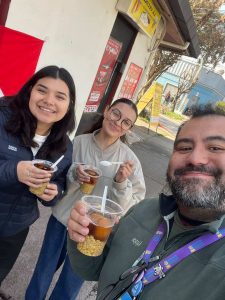
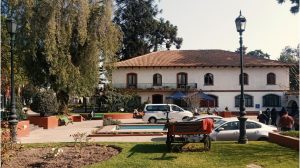 One of the most meaningful parts of my internship was the people, both my coworkers and the community members I worked with. Every day when I arrived at the office, I was greeted with warmth and friendliness by my coworkers. From the very beginning, they made me feel welcome and helped me integrate into Chilean culture in a way that felt natural and genuine. They patiently taught me about the language, shared insights into Chilean society, and introduced me to local customs. We went out to eat traditional Chilean dishes, and they shared their favorite music, films, and stories with me, which deepened my appreciation for the culture and made me feel more connected to the place I was living in. But beyond the office, the most powerful moments came from engaging with the community. Meeting people face-to-face, listening to their experiences, and understanding their needs reminded me why I chose to study sociology in the first place. These conversations made it clear to me that I want a career centered on helping others, not in a distant way, but by being present, listening deeply, and working alongside people to create real change. Seeing their smiles, hearing their stories, and knowing they felt heard and valued was incredibly rewarding. Those interactions weren’t just the highlight of my internship, they reaffirmed my purpose.