Interning in Santiago, Chile: Exploring democratic education alongside complex histories by Lila Chanas ‘28


Name:
Lila Chanas
Class Year: 2028
Majors: Political Science, Spanish

Internship Organization: Momento Ciudadano
Internship Title: Intern
Location: Santiago, Chile

What’s happening at your internship? We would love to hear what kind of work you are doing!

This summer I worked with Momemto Ciudadano, an NGO formed in Santiago, Chile, dedicated to providing research, strategies, and workshops for democratic and civic education across the country. The organization collaborates with local schools to implement gamified lessons that promote collaboration, critical thinking, democracy, human rights, and citizenship. Momento Ciudadano also focuses on professional development and educational instruction, teaching the importance of participation and agency in education, conflict and dialogue, human rights, and the application of democracy from both historical and civic perspectives in Chile.

Attending the exposition at the Museum of Human Rights in Chile titled Un Siglo de Voces: Juveniles de scouts, cristaleros, y pingüinos curated by Momento Ciudadano

Recently, Momento Ciudadano curated an exposition for the Museum of Human Rights in Chile titled Un Siglo de Voces: Juveniles de scouts, cristaleros, y pingüinos, which examined the long history of youth activism in Chile. As an intern, my role involved surveying current publications related to Momento Ciudadano’s mission and pedagogical tools. I provided updated articles for them to use in their mission statement, educational models, and further research. By the end of my two-month internship, I had drafted several comprehensive briefs in professional Spanish, each over 10 pages long, to support Momento Ciudadano’s future endeavors.

Why did you apply for this internship?

I applied to intern with Momento Ciudadano because I was invested in their work on democratic education. I have always found myself drawn to the more tangible side of political science and how it is experienced by the masses every day, and I believe MC’s focus is on just that. Additionally, I was interested in exploring non-profit work and my potential future career interests in the field.

What has been your favorite part of this internship?

My favorite part of this internship has to be collaborating with my coworkers at Momento Ciudadano. The work culture in Chile feels much more approachable than traditional American workplaces. Here, relationships at work are meaningful and significant, and there is a genuine effort to connect, which is often lacking in many American companies. I hope to bring this mindset back to the US as I pursue more professional opportunities, allowing me to build more meaningful relationships with my coworkers and, hopefully, making my work more fulfilling. I have also learned how my coworkers discovered their passions, which will help me as I enter my junior year and further refine my professional interests for the future. For my first experience in the professional world, I am incredibly grateful for the kindness and support of my wonderful coworkers and friends at Momento Ciudadano.

What is most rewarding about your internship?

The most rewarding part of my time with Momento Ciudadano was gaining hope and learning about models for change. Chile, with its complex history of dictatorship, has since felt a strong urgency to implement equitable political representation and strengthen its democracy. In our current political moment in the United States, my hope for politics as a force for good and my role in it has been fading. Since arriving in Chile and engaging with its political and academic spheres, I feel a renewed sense of hope and progress. Witnessing the incredible work that is being done here has been eye-opening.

One of the many mantras I’ve heard from colleagues and at events is that “the youth are not just the future but the present,” and that “discomfort is the sign of progress.” I certainly did not expect my time in this country or at my internship to instill a sense of purpose in me, but I am eternally grateful. Not only have my feelings changed, but I also believe we can look to Chile as a model for protest and progress in our own democracy in the United States. While their politics are far from perfect, their long history of youth activism is powerful. It serves as an important lesson to the youth of the US about their power, role, and significance in politics.    

An Historic Summer in Philly with the American Philosophical Society by Maya Schindler ‘27


Name:
Maya Schindler
Class Year: 2027
Majors: Political Science, Spanish
Minor:
Latin American, Iberian, and Latino/a Studies

Internship Organization: American Philosophical Society
Internship Title: Curatorial Intern
Location: Philadelphia, Pennsylvania

What’s happening at your internship? We would love to hear what kind of work you are doing!

As a curatorial intern at the American Philosophical Society (APS), most of my time was spent working on the very early stages of the museum’s 2028 exhibition, which will be centered around the Arctic. The time frame gave me the freedom to do exploratory research in the APS’s collections and beyond that were guided by my interests. I focused primarily on photography and art related to the Arctic in the mid to late 19th century and saw it connect through a range of materials and topics.

A photograph from the APS collections from painter William Bradford’s 1869 expedition taken by John Dunmore and George Critcherson

At the same time, the 2027 exhibition about Indigenous communities working with the APS collections has more moving parts at the moment and I had a chance to see how they all start to come together. I worked closely with my supervisor on archival and secondary research, collaboration with community partners, and the process of curation. Throughout all of this, I had opportunities to learn more about research institutions and museums through conferences, meetings, and field trips.

Why did you apply for this internship?

A sketch of an iceberg by anthropologist Franz Boas from the APS collections

My interests in and out of the classroom often connect to public history and I love exploring the ways that stories are collected and shared. I was really excited to finally have the chance to dive into this in a museum context and learn more about the intricacies of what is seen as a more “traditional” form of sharing knowledge and history. This internship was a unique chance to combine my experience in research and more public facing community programming, which is important as I start to think about where my academic and professional experience will lead me after graduation. 

What is something you have learned from your internship that you didn’t expect?

An unexpected impact of this internship is that it reshaped the way that I go to museums. There is even more for me to see now that I have learned about the many components that go into making an exhibition. The selection of paint colors, the readability of object labels, loans from other institutions, and more offer insight into the subject itself and how the exhibition was put together.

“Whalers Trapped in the Arctic Ice” by William Bradford at the Philadelphia Academy of the Fine Arts

It was especially interesting to see the celebration of the country’s semiquincentennial across the city and how different institutions interpreted and presented it. Thinking about, for instance, the APS’s exhibition about the reproduction of the Declaration of Independence alongside the Philadelphia Academy of the Fine Arts’ thematic overview of both historic and contemporary art brought up questions about how ideas of freedom have been understood and carried on. This was a useful exercise in how to get the most out of museum visits.

What has been the biggest challenge you have faced at your internship?

When I applied to this internship, I knew it would involve archival research. Without experience or much exposure before, I quickly realized I had a lot to learn about what it actually entailed and how to do my own. Having access to the APS’s extensive collections allowed me to immerse myself immediately. With a broad guiding theme of the Arctic, I saw how easy it was to get overwhelmed, but then find my way by following topics in unexpected directions.

At times, challenges like hard-to-decipher handwriting and uncatalogued collections made the process even more confusing, but I came to understand that the process of navigating these obstacles offers its own unique findings in archival research. The freedom that came with my internship structure and being in an expansive archive taught me how to develop my own research structures and collect information in a way that could then be shared with my coworkers and possibly eventually the public.

Bridget Sweeney ‘28 Explores Film and Community at the AFI Silver Theatre


Name:
Bridget Sweeney
Class Year: 2028
Major: Literatures in English
Minor:
Spanish

Internship Organization: AFI Silver Theatre and Cultural Center
Internship Title: Film Programming Intern
Location: Silver Spring, MD

What’s happening at your internship? We would love to hear what kind of work you are doing!

As an intern in the Programming Department, I mainly assist with the curation of films for series and festivals. This involves administrative tasks and, of course, watching movies! I have been able to watch about a dozen movies so far this summer. After I watch a film, I discuss whether it would have an audience at the theater with the Programming team. In order to practice curation skills, I am also developing a mock series. Some of my other responsibilities have been collecting useful data about the Silver and the films that it screens, managing the Silver’s page on the film social media site Letterboxd, and selecting trailers to go along with the films being screened.

Why did you apply for this internship?

The Silver is screening one of the biggest movies of the summer, THE ODYSSEY, on 70mm film!

As a Silver Spring native, I grew up going to see films at the Silver, which in no small part fostered my love of film. As I have gotten older, I have realized how lucky we are to have such a wonderful resource rooted in our community. The theater allows us to connect with our neighbors and friends over a diverse selection of films. Independent arthouse theaters are less and less common, so I was incredibly eager to have the chance to contribute to such a special and important place.

What has been your favorite part of this internship?

My favorite part about my internship has been building my knowledge of film, especially the unique experiences that come with being at a theater like the Silver. I have had the opportunity to learn about how film series and festivals are programmed, theater-distributor relationships, how films are projected, and so much more. I have encountered films from so many different countries, from new releases to early silent films and small independent productions to blockbusters. There is so much hard work and care that goes into running an independent theater, and seeing this has only strengthened my appreciation for the Silver and other theaters like it, as well as deepening my understanding of film in general, which I will certainly take back to my film classes at Bryn Mawr.

What is most rewarding about your internship?

By far, the most rewarding thing about my internship is getting to invest my time and energy into a community institution with such a storied history that fosters connections between people in Silver Spring and beyond through a shared love of film. The AFI Silver taught me to love film over shared experiences with family, friends, neighbors, and classmates, so I feel very fortunate to be able to help others have that kind of experience with film. It is one of the very best things about Silver Spring, and being able to contribute, even in a small way, is a special opportunity.

Isabel Hoffman ’27: My Summer at Corporación Sopeña


Name:
Isabel Hoffman
Class Year: 2027
Majors: Religious Studies, Spanish

Internship Organization: Corporación Sopeña
Internship Title: Intern
Location:  Santiago, Chile

What’s happening at your internship? We would love to hear what kind of work you are doing!

Typical day in the office with my boss Igor!

This summer I have been interning at Corporación Sopeña in Santiago, Chile, where I work in the legal and migration department. Most of my time has been spent researching Chilean immigration law and turning complicated legal information into resources that migrants can actually use. I am creating two guides: one explaining migrants’ rights and another connecting people with legal, healthcare, educational, and other community resources. It has been really rewarding to know that the guides will continue helping people long after my internship ends.

Why did you apply for this internship?

I applied for this internship because it combined three things I am passionate about: law, public service, and Spanish. As someone who hopes to attend law school, I wanted the opportunity to gain hands-on legal experience while improving my professional Spanish. I was especially excited to work with an organization whose mission is to help migrants navigate a complicated legal system and build a new life in Chile.

Was there anything special about how you found this internship?

Visiting the Museum of Human Rights with the other interns

I found this internship through Bryn Mawr’s partnership with IES Abroad. I knew I wanted an internship where I could combine my interests in law and Spanish while living abroad, and IES matched me with Corporación Sopeña. It ended up being the perfect fit and gave me the opportunity to gain meaningful legal experience while immersing myself in Chilean culture.

What is something you have learned from your internship that you didn’t expect?

One thing I didn’t expect to learn was how much discrimination and prejudice many migrants experience in Chile. Through my research and conversations at Corporación Sopeña, I realized that navigating the legal system is only one of the many challenges they face. It made me appreciate how important accessible legal resources and organizations like Sopeña are in helping migrants build a new life.

Working remotely for the first time? What has that experience been like for you?

Visiting the B’hai Temple on my virtual day and working in their coffee shop!

I worked from home one day a week, and it became one of my favorite parts of the internship. I would find a new coffee shop somewhere in Santiago, get my work done there, and then spend the rest of the afternoon exploring a museum or a different neighborhood. It was a really fun way to experience more of the city while still staying on top of my work.


Mi verano (Invierno) en Chile: Advancing Accessible Information for Migrants by Kelby Booth ‘27


Name: 
Kelby Booth
Class Year: 2027
Major: International Studies, Minor: Spanish
 
Internship Organization:  Corporación Dolores Sopeña
Internship Title:   Summer Intern
Location:  Santiago, Chile
 
What’s happening at your internship? We would love to hear what kind of work you are doing!  

View of Santiago from the teleférico on Cerro San Cristóbal

I am in Santiago, Chile with IES! IES has paired me with Corporación Sopeña, a non-profit focused on providing workshops, legal services, and general support for low income and migrant communities. At Corporación Sopeña I am working with a team to create accessible information around migrant rights and resources through videos that will be attached to the non-profits website. Our team has researched laws on immigration, resources for migrants, and have held conversations with the community to identify gaps of awareness. The constant changes and feelings towards immigrants has created fear within the migrant community living in Chile and our hope is to alleviate this fear through the spread of information. 

My co-interns and I at our shared desk

An alley in Valparaiso

 Not only am I interning in Chile this summer, but I am also enrolled in two courses. One of my courses is my internship seminar where I learn about work culture and labor laws in Santiago and Chile as a whole. This class allows me to reflect on my experience at my internship and gives me the space to understand and adjust to the Chilean work culture. My second course is Spanish for Professionals where I learn about life in Chile. This includes looking into the history and politics of Chile and how they have shaped health care, education, and daily life. Because my internship is in Chile, I have had the opportunity to explore Santiago, Valparaiso, Viña del mar, and the Atacama desert.

Why did you apply for this internship? 

I applied to the IES program because I want another opportunity to immerse myself in another culture and language. I have been studying Spanish throughout college, but I feel I make the most progress when I am immersed in the classroom, work, and home. IES also advertised that they place a lot of students with non-profits and that’s something I am interested in doing post-grad. I have worked with non-profits and had internships in the U.S. but I thought it would be a beneficial experience to understand work culture in another country. Specifically with non-profits, I wanted to learn about the approaches and strategies that these organizations use to support their community.
 
What has been your favorite part of this internship?

My favorite part of my internship at Corporación Sopeña is the flexibility of projects. When we all started with the organization they gave us an overview on how they operate, the services they provide or have provided in the past, and some areas that they felt needed attention. After this, each of us created project proposals based on the information the organization gave us and based on our own interest. With the flexibility and the structure of my internship, I was able to create a project that pertained to my personal and professional interests and skills.
 

Can you talk about the skills you are learning and why they are important to you? 

I think the most obvious skill I am learning is how to use my Spanish in a professional setting but also in a way to convey important information. Using Spanish in a professional context has allowed me to expand my vocabulary, strengthen my grammar, while also giving me a new level of confidence. While I think learning Spanish in an academic setting is useful, it’s equally important to take the skills you learn in the classroom and practice them in a real world context. The whole point of learning a second language is to learn and communicate with others, and when you immerse yourself you are exercising your skill. Immersing yourself in a language gives you a new sense of confidence which is key for communicating in a second language because you’re not focused on having perfect grammar or on the details but rather you are focused on understanding each other. 

In addition to improving my Spanish skills, I am also using my creative abilities. At my internship I am doing research on the laws and government assistance for migrants in Chile, but I am also able to use my creative skills to create videos. In general, I would consider myself an artistically creative person but it is rare that I am able to use this in class or at work. Not only am I using my creativity to create informational videos, but I also need my creativity for my project proposal and general problem solving.  

Sarah Kurth ’28: Paleography and the Spanish Inquisition

Name: Sarah Kurth
Class Year: 2028
Major: Intended History of Art, Spanish
 
Internship Organization:  Bryn Mawr Department of Spanish
Internship Title:   Digital Humanities Fellow
Location:  Virtual/Salt Lake City, UT
 
What’s happening at your internship? We would love to hear what kind of work you are doing!  


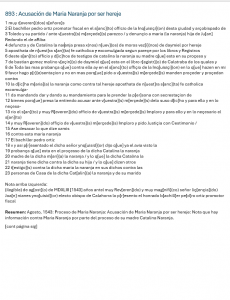
I’ve been transcribing Spanish Inquisition trial documents housed at the University of Pennsylvania. I completed transcriptions of five trials, each centered around a woman accused of being a false convert from Islam to Catholicism. I read through the folios in their entirety, created a plain-text copy in a working document, and included short summaries of the content at the bottom of each page. To finalize my internship, I authored a blog published at UPenn. I’ve really enjoyed getting a look at what daily life looked like for the five women before and after their imprisonments by the Inquisition.
  

Folio 893 from the Henry Charles Lea Collection Ms. 728

Why did you apply for this internship?

I’d been doing Paleography work during the Spring Semester with Professor Phipps, and had fallen in love with the process of transcription as well as the content within these primary documents. I thought that this internship would be an amazing opportunity to explore what a focus of career in a similar field could look like. I’m so excited to continue my work this year and in the future, potentially through a senior thesis.
 
Was there anything special about how you found this internship? 

I found it through being the facilitator for Professor Phipps’ Paleography Working Group, a weekly meeting of interested students that I’m excited to continue working on this coming year. 

What has been your favorite part of this internship? 

my transcription

I was consistently moved by the stories included in the trial’s witness testimonies. There were so many beautiful moments of female relationships across the five trials. It’s staggering to witness events that occurred 500 years ago, that could have just as easily happened last week, like two sisters being sent to sleep over at their friends house while their parents were out of town. 

Can you give us three adjectives and three nouns that describe your internship experience? 

Tragic, beautiful, nuanced. Spain, religion, justice. 

Can you talk about the skills you are learning and why they are important to you? 

Paleography is such a specific skill, and I’ve loved getting to familiarize myself with specific notary’s scripts, as well as the general vocabulary and formatting of Inquisition trials. Even if I don’t go into a paleography-related field as a career, I think that the critical thinking skills and added Spanish vocabulary will aid me in the future. 

What is most rewarding about your internship? 

Getting to familiarize myself with women whose lives were not evaluated positively. It’s my hope that my work this summer will make the trails more accessible to future engagement and research, broadening the impact of these women’s trials on Inquisition scholarship. 

Was this internship what you expected it to be? 

Everything and more! 

Lourdes Sankar ’27: Exposing injustices: An international and immersive experience


Name: Lourdes Sankar
Class Year: 2027
Major:  Political Science
Minor: Spanish, Health Studies
 
Internship Organization:  Bryn Mawr College Political Science Department and University of Toronto, Canadian Government
Internship Title:   Research Assistant
Location:  Remote and Mexico City, Mexico
 
What’s happening at your internship? We would love to hear what kind of work you are doing!  

This summer I have been interning for Dr. Elizabeth Corredor, Professor of Political Science at Bryn Mawr. In the beginning of June we went to Mexico City for a Women’s Peace and Security conference where I acted as the note taker and translator for Professor Corredor. I then have been tasked with writing the policy report that will later be sent to the Canadian military to help promote an anti femicide agenda. Traveling with Professor Corredor and spending time in Mexico City allowed me to immerse myself within the culture and work on my Spanish while I was there. Meeting such incredible women who are passionate about the extreme amounts of femicide in Mexico was so inspiring. I am able to take my newfound research and policy report skills back to Bryn Mawr with a new global view.
 
Why did you apply for this internship?  

I applied for this internship because I have taken two classes with Professor Corredor and loved her passion about Women and International Politics. I wanted to research under her support and learn from a professional perspective.

Was there anything special about how you found this internship? 

The community of people that I met: the amazing women in Mexico, my felllow research assistants, and Professor Corredor. 

What has been your favorite part of this internship?

Getting to work along side such a passionate group of people and getting to experience a new city. 

What is something you have learned from your internship that you didn’t expect? 

I learned how to code in excel for political science research!

Working remotely for the first time? What has that experience been like for you? 

I have had to be dedicated to creating my own schedule and making sure I meet my deadlines.  

What has been the biggest challenge you have faced at your internship? 

Not having a set schedule and learning to create that for myself when I always have had a set schedule made for me. 

Can you give us three adjectives that describe your internship experience? 

Immersive, transformative, collaborative 

What is most rewarding about your internship?

Creating fantastic connections with other students and my professor.

Was this internship what you expected it to be? 

It was everything and more. 

Ayla Conn ’27 Spends Summer Interning with FORA

Name: Ayla Conn
Class Year: 2027
Major:   International Studies
Minor: Spanish, Linguistics
 
Internship Organization:  FORA
Internship Title:   Administrative Restorative Justice Intern
Location:  Chicago, IL
 
What’s happening at your internship? We would love to hear what kind of work you are doing!  

What does a day in your internship look like? Forging Opportunities for Refugees in America, or FORA, is a nonprofit located in the heart of the community it serves, a thriving immigrant neighborhood in Northern Chicago. They’ve grown from working with 12 students to nearly 120, providing “High-Impact Tutoring” (HIT) to K-12 refugee students to support their adjustment into Chicago schools and ensure they feel caught up to grade level. As an Administrative Intern, my typical day at work is dynamic—it starts with two 2-hour tutoring sessions, where I work one-on-one with students on math facts and reading fluency. HIT activities might look like warming up with math games, talking through problems in a workbook, or reading a book out loud, pausing for comprehension questions and to sound out new words on a whiteboard. With up to 80 students in the building at a time, the room is always full of energy, from the start of the day at 9:00 until students start to trickle out at 1:30. Then, in the afternoons, the interns stick around to help FORA staff with a variety of projects. I’ve gotten to work directly with several members of staff, including our managing director, to support our budding summer speaker series, coordinate and advertise community events, research new solutions to keep our data organized, and more!

Why did you apply for this internship?  

Why did you apply for this internship? I grew up in the Chicago area, so I was excited by the opportunity to return home to work at an incredible organization located just 15 minutes from my front door. I’ve worked in a handful of tutoring-adjacent jobs on campus, including in the Writing Center and as a language TA, and I hoped to expand those skills while making an impact in a new environment. I also wanted to learn more about how a small, community-driven organization like FORA works behind the scenes.
 
What has been the biggest challenge you have faced at your internship? 

The adjustment from tutoring undergraduates to working with 7-year-olds! The students at FORA are all such hard workers, whether they’re in first grade or rising highschoolers, but working with kids presents a distinct set of challenges that has been a learning curve for me—especially during the summer, when most of them would rather be spending a day relaxing at the beach than wrapping up their subtraction workbook. Just over halfway into my time here, I am starting to feel confident in the strategies I’ve developed to keep different types of learners engaged, and I know I have learned as much from the students as I teach!  

What is most rewarding about your internship? 

The most rewarding part of working at FORA that I could not have expected is the extent to which I’ve felt able to make an impact. Being involved in a student’s “aha!” moment and seeing how they grow over the course of the 8-week summer semester is incredibly valuable. In particular, I’ve been consistently working with one rising sixth grader who was new to FORA this summer. Seeing her accomplish such amazing academic goals, like completing two levels on our math app and finishing a chapter book in the first few weeks alone, in addition to making connections with other students and tutors, has been such a privilege to witness. Our summer speaker series has also been such a fun surprise, as I’ve learned about the career trajectories of a wide range of FORA and Chicagoland community members, from local politicians and business owners to board members and former tutors, and had the opportunity to be in contact with many of these speakers to coordinate their visits. 

Cass Fischer Murphy ’26 Explores Immigration Law in Philadelphia


Name: Cass Fischer Murphy
Class Year: 2026
Major: Spanish
Minor: Gender and Sexuality Studies, Philosophy
 
Internship Organization: Esperanza Immigration Legal Services
Internship Title:   Legal Intern
Location:  Philadelphia, PA
 
What’s happening at your internship? We would love to hear what kind of work you are doing!  

 I work at Esperanza Immigration Legal Services, the small legal department of the nonprofit Esperanza, which serves low-income immigrant communities in Philadelphia. Due to its limited capacity for representation (there is only one attorney), its legal services primarily comprise work outside of the courtroom. A large amount of this work involves assisting people with their citizenship applications. Though a relatively lower-risk immigration status to be in, the process is still difficult for our clients for a variety of reasons, be they related to finances, language, age, or literacy. Completing the application for naturalization can involve assisting clients with their taxes, medical records, among other bureaucratic things. Naturalization clients are very rewarding to work with, as citizenship represents a big step for them and is easy to achieve with the right advocacy. Two of my most happy moments at work have been interpreting for a woman who passed her citizenship interview, and co-teaching a citizenship interview test prep class. The second-most common kind of petition I have dealt with is asylum– a much riskier and harder to access legal protection. Eligibility for asylum is multi-tiered and fairly specific, and highly influenced by contemporary politics. Constructing a claim involves a balance of personal testimony, country conditions, and legal analysis. Filing pro se asylum applications has illuminated to me the vast failures of the US immigration system. For example, the fact that the executive branch was legally able to cancel Temporary Protected Status for 350,000 Venezuelan asylum seekers in the US without advance notice highlights the chaotic and unstable nature of the system as a whole. It is very disheartening to not be able to give an answer to asylum seekers when they ask about their futures– nothing is certain anymore. Yet, helping someone file their application makes a huge difference for them, even if their chances of it being granted are slim. It isn’t up to me to decide what work is “worth it” or not– though the system makes it harder and harder to help people, it means that the need for immigration advocacy is even more urgent.

Why did you apply for this internship?  

I’m interested in pursuing immigration law as a potential career, and for that reason I decided to intern at an immigration nonprofit. I want to work in immigration law because it’s one of the most pressing issues of our time, and because it allows me to draw on my studies in Latin American history.     

What is something you have learned from your internship that you didn’t expect? 

My experiences with immigration law have shown me the real-life effects of the historical events I have studied here at Bryn Mawr. Through my studies in Latin American history, I understand that a lot of the turmoil plaguing Latin America today is a direct consequence of U.S. interventions and extractivist policy dating from the 20th century to today. The U.S. has made itself rich from Latin America, and then it exploits and dehumanizes the people that it has displaced. That’s what makes recent events all the more galling. Yet, I’m glad that I am able to use my studies in a way that directly helps people. 

Can you talk about the skills you learned and why they are important to you? 

For anyone interested in helping asylum seekers, many nonprofits will have regular clinics where you can help people apply for asylum, both remote and in person. Philly has a lot of great organizations– I would recommend looking at the member groups of the Pennsylvania Immigration Coalition to start! 

Laurel Gabbard ’26 Works in the Archives in Santiago, Chile!


Name: Laurel Gabbard
Class Year: 2026
Majors: History of Art, Spanish
Minor: Museum Studies
 
Internship Organization:  Archivos de la Facultad de Artes en la Pontificia Universidad Católica de Chile
Internship Title:   Archives Intern
Location:  Santiago, Chile
 
What’s happening at your internship? We would love to hear what kind of work you are doing!  

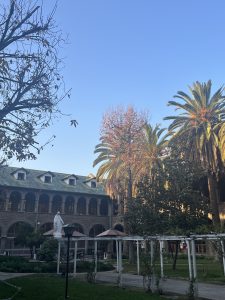
Pontificia Universidad Católica de Chile

This summer, I have been interning in Santiago, Chile, working in the archives of the School of Arts at the Pontificia Universidad Católica de Chile. As an intern working in the theater archives, I have been introduced to a wide array of archival materials, including but not limited to documentary footage, interviews, photos, letters, posters, and theater programs. My main task consisted of transcribing, subtitling, and translating three documentaries that focus on different elements of Chilean theatrical history, all of which, in some capacity, focused on theater as a revolutionary act that can operate as a push against state power and dictatorship. I also transcribed interviews conducted with Alberto Kurapel and Susana Cáceres, Chileans living in exile in Canada during the dictatorship, and who, in their time in Montreal, formed a theater company that produced acts based on their own experiences in political exile. I also had the chance to meet with the subject of one of the documentaries, Jacqueline Roumeau, the founder of an organization that coordinates theater, and more broadly, art opportunities, within prisons as an act of rehabilitation and reintroduction into society after incarceration. My supervisor recently presented the three documentaries that I subtitled at a three-day long event at the Chilean embassy in Buenos Aires, Argentina, and knowing that I contributed to the accessibility and understanding of these visual archives is very exciting!
 
Why did you apply for this internship?  

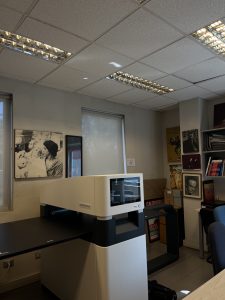
Digital Humanities Lab

I originally applied for the IES Abroad summer internship program, along with Career and Civic Engagement funding knowing that I wanted the opportunity to live and work in a Spanish-speaking country and get more comfortable with my professional abilities in my second language. As I worked with IES to find an internship placement, I knew I wanted to be in the arts and humanities sector, so when I was presented with the opportunity to interview for a position in the archives of the School of Arts, I knew that would receive the guidance and experience I was looking for!
 

What has been your favorite part of this internship?  

My favorite part of this internship, besides the professional experience I have gained, has been getting to know my coworkers and supervisors, and in doing so, gain insight not only into professional life in Chile, but also being able to learn tons about Chilean culture, history, social issues, and be a part of the day to day office conversations! My coworkers, in addition to other university-age interns at the office all welcomed me with open arms and helped me learn tons about what it is like to be young in Chile, and I feel very lucky to have had this experience of full linguistic and social immersion in addition to my professional experience.   

What is something you have learned from your internship that you didn’t expect? 

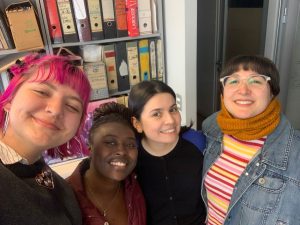
Coworkers and I on my last day!

As a history of art major, I came into this internship with a lot of knowledge about art history, but less about theater and performance art as archival materials. I have been able to learn a lot about the way that archives can preserve the history and memory of works of art and performance that are less tangible and more fleeting. In this case, it has to do with the way that the archives at my internship hold onto the memory of Chilean theater, although one can never experience the exact moment of the production in the same way again. The collections of videos, audios, interviews, pamphlets, posters, and other mediums that the theater archives hold has pushed me to reconceptualize my understanding of what forms of art are easily “archivable”. As I prepare to begin my senior thesis this coming year, I have been considering the way that the corporeality and tangibility, or lack thereof, of performance art can be catalogued and remembered, and how our perceptions of history and memory are changed by how we register art as a physical or non-physical item. I did not go into my internship expecting that something that falls into the realm of theater performance could be so related to what I may want to write my thesis on, but I feel lucky to have had this experience and open my mind to a new realm of critical thinking in the field of art history!