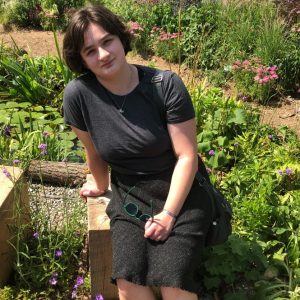
Esther Rosi-Kessel ’27: Digital Accessibility Internship


Name:
Esther Rosi-Kessel
Class Year: 2027
Majors: Sociology, German

Internship Organization: Bryn Mawr Library & Information Technology Services (LITS)
Internship Title: Digital Accessibility Internship
Location: Bryn Mawr, PA

What’s happening at your internship? We would love to hear what kind of work you are doing!

This summer, I learned about accessibility for digital materials- this means making sure that online materials, like documents, are accessible to people with disabilities and people who use assistive technology, such screen readers. I then trained Bryn Mawr faculty and staff on the best practices for creating digital materials, and taught them how to make their readings accessible, and helped them remediate their courses. Over the course of the summer, I helped remediate ten courses!

Why did you apply for this internship?

I have low vision, and I occasionally use text to speech to read my course materials, but I wanted to learn how to help other people who use technology in different ways, and to understand the best ways to make things accessible to as many people as possible. I’m also potentially interested in going into a field relating to accessibility or disability, so I wanted to know more about the options available to me.

Was there anything special about how you found this internship?

I saw a poster in Campus Center! I had no idea this was an option, and this was an extended application deadline, so I got lucky!

What has been your favorite part of this internship?

Getting to know the professors I’m working with and finding ways to help them.

What is something you have learned from your internship that you didn’t expect?

So many websites and documents that claim to be accessible still have lots of issues.

Can you talk about the skills you are learning and why they are important to you?

I’ve gained a lot of problem-solving skills around technology, which I think will be super helpful for learning any kind of new technology. I’ve also learned how to teach technological skills to people with a really broad range of comfort levels using tech, and being able to work through things in a way that everyone can understand is a really important skill. I have to be very clear, patient, and always remember to check in, so that everyone can feel confident in what they’re learning. I’ve also built up perseverance for working through difficult or time-consuming documents.

Can you give us three adjectives and three nouns that describe your internship experience?

Adjectives: detail oriented, technological, rewarding

Nouns: PDFs, computers, trainings

What is most rewarding about your internship?

Seeing accessibility scores going up, and positive feedback from professors!

Interning at Timeout Foundation by Isabel Gerlach ’28


Name:
Isabel Gerlach
Class Year: 2028
Major: German Studies
Minor:
Education Studies

Internship Organization:  Timeout Foundation
Internship Title: Student Intern
Location: Breitnau, Germany

What’s happening at your internship? We would love to hear what kind of work you are doing!

Our newest calf, Freya, and her mama, Frederike, the morning after she was born

This summer I am interning with Timeout Foundation, a youth welfare service, where I am building relationships with and help care for our kids who live with us. We also have animals (cows, goats, sheep, pigs, and alpacas), our barn, pastures, and land that we take care of each day. Much of my time at Timeout is spent working together with the kids on tasks around the farm, from their morning and evening stall tasks for the animals to building fences and cutting grass. I also drop our kids off at and pick them up from classes and sports, accompany them to doctor appointments, and pick up medications, clean laundry, and prepare meals. In our office room I am learning to concisely document each kid’s day and about techniques to navigate emotions and deescalate conflict. My work at Timeout Foundation this summer is completely in German, which has been an amazing opportunity to gain more vocabulary and fluency in my German language skills, while also learning about the culture here in southwest Germany

Why did you apply for this internship?

Lovely view of mountains from the house

I applied for this internship because it felt like the perfect intersection of German and Education studies. I would be able to work with kids ages 10 to 17 and explore the pedagogic systems of Timeout Foundation, while putting my German knowledge to use and challenging myself to further grow my language skills and cultural understandings of Germany. My internship with Timeout Foundation is also hosted by Innovation Academy in Freiburg, which is the organization that hosted students from the Climate Change 360 and that I grew familiar with throughout this past fall semester.

What has been your favorite part of this internship?

I have found the farm aspect of my internship quite meaningful. Building strong, trusting relationships with kids is quite difficult in a short amount of time, however working on the farm and accomplishing tasks together has helped our relationships grow stronger. It has also been amazing to see how independent the kids are around the farm and how much knowledge they have about animals, for building items, using tools and machinery and their love and care for animals. I have found the farm tasks most difficult throughout my internship due to all the new vocabulary, but it feels satisfying to accomplish tasks and I learn new vocab each day on the farm. The calves are also so adorable!

Was this internship what you expected it to be?

This summer is Innovation Academy and Timeout Foundation’s first time collaborating to offer an internship opportunity, so I had no clear image of what the internship entailed or how it might go. I think the outcome has been even better than I could have hoped for. The team I work with is absolutely amazing and I am gaining valuable knowledge and ideas from them. I have been learning much about culture, social relationships, and emotional regulation through working with our awesome kids. I also would not have otherwise had the opportunity to hang out with our kids and sweet animals each day with such a beautiful view of the Black forest in the background!

Audrey Pfister ’28 Reflects on Summer in the Engert Lab


Name: Audrey Pfister
Class Year: 2028
Majors: Neuroscience, German Studies
 
Internship Organization: Engert Lab, Harvard University
Internship Title: Research Assistant
Location: Cambridge, MA
 
What’s happening at your internship? We would love to hear what kind of work you are doing!

This summer, I am working in the laboratory of Professor Florian Engert at Harvard University, under the supervision of Research Fellow Dr. Christophe Dupré, to map the neural circuitry underlying somersaulting behavior in the freshwater polyp Hydra vulgaris. My work builds on the electron microscopy (EM) tracing I completed last summer, in which I mapped synaptic connections between sensory neurons, interneurons, and glue nematocytes involved in tentacle attachment during summersaulting.

My primary tasks include tracing individual cells in electron microscopy (EM) data using the VAST software platform, slice by slice, to identify synaptic connections; producing 3D reconstructions of traced cells using MATLAB and 3ds Max; and augmenting an existing connectivity matrix. I am particularly focused on two sensory neurons, SN5 and SN6, which converge onto many of the same downstream glue nematocytes, and whose coordinated role in tentacle attachment during somersaulting is a central question of this project.

Why did you apply for this internship?

I first applied for this internship in the spring of 2025 because I knew I wanted to work in a biology lab, as I was interested in STEM. I chose the Engert lab specifically because I am interested in their research on brain circuits, as they allow me to better understand complex behaviors. Dr. Christophe Dupré’s research on the Hydra vulgaris stood out to me because it was a model organism I had not heard of before, and there was not as much research on its neural circuit as other model organisms like C.Elegans and zebrafish.


Can you talk about the skills you are learning and why they are important to you?

I am learning both my technical skills and my conceptual understanding of neuroscience research. On the technical side, I will continue to develop proficiency in electron microscopy data analysis and in VAST, a specialized software platform for tracing and reconstructing neural structures. I will also gain experience with MATLAB and 3ds Max to produce 3D reconstructions of traced cells, building skills in scientific visualization that are broadly applicable in biological research. Additionally, I will gain experience constructing and interpreting connectivity matrices, which is a vital tool in connectomics for representing synaptic relationships across a neural circuit.

More broadly, I expect to develop a stronger understanding of how individual synaptic connections scale into circuit-level function, and how a simple organism like Hyrda can serve as a powerful model for studying fundamental questions in neuroscience. Working with Dr. Dupré in an active research environment will also give me insight into the day-to-day practice of scientific inquiry, from forming hypotheses about circuit organization to working through data in EM slices.

What is most rewarding about your internship?

The most rewarding part of my internship is knowing that by studying simple organisms like the Hydra vulgaris, I am working to further the field of Neuroscience. As I am interested in working in the research field post-grad, I know how important it is to get hands-on experience, and I am grateful for this opportunity. Being my second summer working under Dr, Dupré, it is especially exciting to be continuing the same research and building my experience and interest in the field. The tools I am using are ones that will be useful in future research, and to those I would like to conduct on my own. 

Hannah Carroll ’26 Interns at The Weitzman  


Name: Hannah Carroll
Class Year: 2026
Major: History of Art, History, German Studies 

Internship Organization: The Weitzman National Museum of American Jewish History
Internship Title:   Curatorial Intern
Location:  Philadelphia, PA
  
What’s happening at your internship? We would love to hear what kind of work you are doing!  

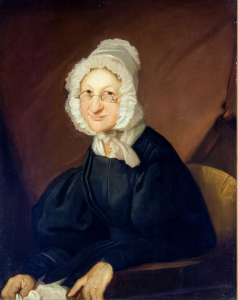
Who is she? Portrait of Mrs. N Eckstein by Louis Lang, 1839

Museums are surprisingly dynamic workplaces, meaning no two days are ever the same! I have done so many different things, from accessing objects, to getting really good at using an office scanner while digitizing old exhibition files. The Weitzman is hoping to unveil some new and improved exhibitions in the coming years, and many of the tasks I have worked on have been related to the museum’s upcoming temporary exhibition for the semiquincentennial (250th anniversary) of the Declaration of Independence called The First Salute. What I think is so amazing about this exhibition, which will follow the story of the Jewish community on Sint Eustatius in the Caribbean and its involvement with the American Revolution, is that it really highlights the sometimes unexpected dynamism and diversity (of peoples, of goods, of ideas, etc.) present in the 18th century Atlantic World. I cannot wait to see and share the final project with all of you next spring!
 
Why did you apply for this internship?   

Even before working there, the Weitzman was probably one of my favorite museums in Philadelphia. Believe it or not, it is the only Jewish museum in the country which focuses exclusively on telling the stories of the American Jewish experience from the 17th to the 21st century. Working in a museum was something I have really wanted to do since I started college, and the Weitzman unique collection and specialties would help me bridge connections between many of my academic passions, such as American history and Jewish history, as well as object interpretation and material culture. I also feel that working in a Jewish museum and helping to tell these stories of American Jewish life is particularly needed in our current moment in which anti-Jewish bigotry has become commonplace in our politics and culture.  

Was there anything special about how you found this internship? 

Yes! I had really been struggling in my search for an internship, and I was talking to one of my friends who was working at the Weitzman as part of the Praxis program this spring and really loved the work she was doing. Even though I am probably not going to be able to do a Praxis next year, I reached out to the Praxis director, Tiffany Stahl, who said that she heard the museum was actively searching for summer interns and gave me the email of my eventual supervisor. I know this is incredibly schmaltzy, but if you are struggling in your search for internships, it never hurts to ask for information from friends, your advisors, or even the Career and Civic Engagement Center — it is their job, after all!
 
What was your favorite part of this internship?  

“Everything” is kind of a silly answer, but I mean it! I have loved both the breadth and depth of my work there.
  
Can you talk about the skills you are learning and why they are important to you?

Learning how museums work has been very fulfilling as an art history major, because it has shown me what kinds of things I can do with my degree as I pursue further study. Understanding a museum from the inside out has also helped me think about how to research better, especially as I prepare to write my thesis. I have been working on solving the mystery of one particular painting in the museum’s collection, a portrait of a woman from the late 1830s. We know basically nothing about her except for her last name and the artist who painted her portrait. Uncovering her story has led me down so many different paths, as I research the life of a woman who, pending further evidence, I suspect may be the sitter. It has also been interesting (and sometimes a little frustrating) to read the internal records we have on the painting, and see how others who have attempted to identify her have tried and failed, and at times made and propagated shaky claims about who she was, somewhat like a game of art-historical telephone! Hopefully if I am similarly unable to confirm her identity, I can at least leave a better framework and documentary trail for the next person in my stead. The lives of American Jewish women before the late nineteenth century are quite under-researched (although this is slowly changing), and I hope that in the future my own research will build upon illuminating more stories like this! 

Interning at the UNESCO Black Forest Biosphere Reserve by Ellen Valliere ’27 


Name
: Ellen Valliere
Class Year: 2027
Major: German Studies
Minor: International Studies
 
Internship Organization: UNSECO Biosphärengebiet Schwarzwald
Internship Title:   Public Relations Intern
Location: Schönau im Schwarzwald, Germany
 
What’s happening at your internship? We would love to hear what kind of work you are doing!  

The UNESCO Black Forest Biosphere Reserve works to preserve the unique cultural and natural environment in Southwest Germany by encouraging collaborative relationships and exchange between conservationists, farmers, local businesses and educators alike. My role involves maintaining the team’s social media (@biosphaerengebiet_schwarzwald) and supporting community outreach through educational events, research projects, and regional tours. Working in public relations provides insight into each of the Biosphere Reserve’s interwoven departments: 
  • Land Use 
  • Nature conservation, Landscape Care, Research, and Monitoring 
  • Regional Development, Tourism, and Economy  
  • Education, Society, Culture, and Social  

The Biosphere’s team works alongside the local community to further the interests and efforts described by each department. Environmental sustainability is at the forefront of all the Biosphere Reserve’s projects, especially with drought, floods, heat waves and other effects of climate change already evident in the region.

Why did you apply for this internship?  

I found the internship at Biosphaerengebiet Schwarzwald through Dr. Margaret Strair in the bi-co German Department and Innovation Academy in Freiburg – an independent non-profit offering sustainability-based education in the region. I pursued the opportunity, in the interest of practicing German and supporting global climate justice. Also, so I could spend the summer outside, surrounded by gorgeous nature!

What has been your favorite part of this internship?
 
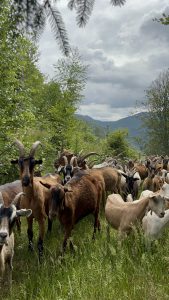
 One highlight I witnessed was the opening of a modern forest pasture in June, where 150 goats were brought to graze in a section of dense forest for three days. Forest grazing was a traditional Black Forest farming practice for centuries before being banned in the 19th century for its toll on the land. However, when practiced in moderation the goats help clear invasive plants, allowing more space and light into the forest. This greatly benefits the species diversity of native insects, flora, and fauna. By integrating the knowledge of both environmentalists and farmers, the Biosphere Reserve and the local town of Utzenfeld have been able to renew the tradition — it was beautiful to see all the happy goats!

What is most rewarding about your internship?  

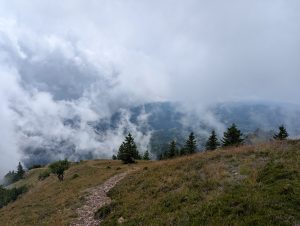
It’s been super rewarding to feel my German improve week by week, especially the moments when I realize I’m able to converse and express myself more naturally! Hiking through the woods to and from work everyday has been similarly rewarding, as it too gets a bit easier each time. Overall, I am inspired by the widely shared commitment to caring for the land here in the Black Forest – ensuring that a mosaic of forest, meadows, pastures and villages over 1000 years old may live and grow together long into the future.