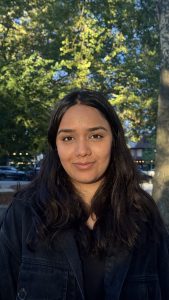

Name: Linnea Siderhurst
Class Year: 2027
Major: Mathematics
Internship Organization: livMatS Cluster, University of Freiburg
Internship Title: Research Intern
Location: Freiburg, Germany
What’s happening at your internship? We would love to hear what kind of work you are doing!

I am interning at the livMatS cluster of the University of Freiburg, which is a part of the department of engineering. This research cluster takes inspiration from the natural world to create bio-inspired technology and engineering solutions. One current research area at livMatS is hygromorphic actuation: an energy-free technology with applications in sustainable architecture. Under the supervision of my mentors, I am working on a simulation which will hopefully provide insight into the chemical physics driving hygromorphic actuation. So far, I have been doing literature reviews on topics such as polymer physics and molecular dynamics simulation, and have used Python and LAMMPS to investigate the effects of various parameters on my simulation.
Why did you apply for this internship?

This internship is run through the Innovation Academy summer internship program, which provides the opportunity for students to live in Germany and participate in sustainability-focused internships. I was drawn to this because of the opportunity to travel and because I saw that doing research at the University of Freiburg was one of the internship options. I am hoping to continue doing research in some capacity in graduate school, so this program seemed like the perfect way to try out research and get to experience a new place! I would definitely recommend this program to students who have not gotten the chance to study abroad and are passionate about climate justice and sustainability.
What has been your favorite part of this internship?
My favorite part of this internship has been the location and my lovely fellow Innovation Academy interns. Freiburg is a beautiful city with so many fun summertime events such as festivals, flea markets, and pride events! I’ve also loved being in a place with so much access to history. I’ve greatly enjoyed seeing all the historical architecture around Freiburg and have gotten to explore some amazing art and history museums. In our first week here, we even had the opportunity to visit the reconstructed Chateau du Haut-Koenigsbourg castle in Alsace, France. And, of course, I have to shout out the friends I have made here for adding so much to this experience. The simple moments of sitting outside and chatting about life and getting to know new people might even beat out the breathtaking views and castles.
What is something you have learned from your internship that you didn’t expect?
I expected to be spending most of my time working in a laboratory setting and completing mostly experimental work. However, my research project is entirely theoretical and simulation-based. This was definitely an interesting adjustment, and it was stressful at first because I felt like I didn’t really know what I was doing, and it was different from what I had envisioned. Now that I have gotten a bit more comfortable, I have realized just how much this project has been teaching me. I have gained computing skills such as coding with Python and tuning LAMMPS simulations, and I have learned the importance of adaptability in a research environment. Things almost never go the way they do in our heads, and it is so important to learn how to handle changes (and maybe even enjoy them, but I’m not quite there yet).


 The Swei lab studies disease ecology. The project that I am working on in the lab is a CDC-funded collaborative project across the country. We are studying the effect of preemptively treating the animals that ticks feed on to lower the rate of Lyme disease transmission. Our section of the project looks at the spread of Lyme disease around the SF Bay Area. We go out into the field and collect ticks. We then take those samples and identify their genus and species with microscopy. Once we have identified their species, we can take Ixodes Pacificus Nymphs (IPAC N) (genus, species, life stage) and extract their DNA. IPAC N are the ticks that can carry Lyme disease, while the nymphal stage is the most likely to have the infection. The extracted DNA is then processed with nested PCR to test for Borrelia burgdorferi, the bacterium that infects the ticks with lyme.
 This internship closely aligns with my interest in disease management and vaccines. After the pandemic, I found myself interested in researching the science behind disease prevention. I was especially interested in this lab because it studies vector-borne diseases transmitted by ticks to humans. A lot of talk about contagious diseases covers ones that are spread from person to person. Lyme disease, however, is not, yet it still is a large problem across the coasts. This internship would also allow me to be close to home this summer.
 One thing that surprised me during the internship was the field work. I didn’t know that I was going to be helping with field work as well as in the lab. However, it was a valuable experience. I have gained so much more respect than I already had for people who do field work. In order to collect samples for my lab (tick drags/camera work) one must hike up into the mountains. Then hike OFF of the path and onto steep hill sides in order to better collect samples as that is the area that ticks prefer to live in. Not only is it incredibly physically challenging, it is mentally difficult too. Not many people have ever had the goal of getting ticks on them. In the end I learned that although I may not be cut out for field work I am more capable than I thought.


 I remember talking to my family and friends after my LTT internship in Ghana last year and really loving the impact of a great internship. We were brainstorming about the next summer and, since I loved CS and Math so much, maybe my next internship should combine the two at a big company—naturally, Google came up in the conversation. Then, in early fall 2024, my school arranged a trip to Google’s New York offices where we met a couple of TriCo alums working there in different roles. It was an eye-opening experience: the culture felt exciting, the work everyone was doing sounded fascinating, and yes—the lots of mini kitchens didn’t hurt either. (I’m not saying I applied just for the snacks… but the snacks didn’t hurt.) After those conversations with alums, I knew an internship at Google would throw me in the deep end—with mentors to guide me, teammates to brainstorm with, and projects that would stretch me far beyond what I’d experienced before. And honestly? I also wanted to prove to myself that a kid from Nairobi could find her place, contribute, and learn in a space as massive and inspiring as Google.
 Not really—I didn’t stumble on a secret portal or have an insider tip. There are countless GitHub repos and forums that mention Google’s internship, so as soon as applications opened, I just threw my hat in the ring. Was I expecting to hear back? Honestly, no. With the thousands of applications Google must get, I assumed mine would quietly disappear into the void. But then, on my birthday, I got the email inviting me to interview. It felt less like perfect timing and more like the universe giving me a little wink: “Yep, this one’s for you.”