Finley Waits ’27: Vienna Proved Me Wrong. I’m Glad It Did.  


Name: 
Finley Waits
Class Year: 2027
Major: International Studies, Minor: Data Science

Internship Organization:
SCI Austria and The EU Research & Development Agency
Internship Title:   Project Management Intern & Research Assistant (Respectively)
Location:  Vienna, Austria

What’s happening at your internship? We would love to hear what kind of work you are doing!

At SCI Austria, I support the administrative and operational side of running an NGO. This means I am working with platforms like ERAMUS+ and YouthPass, adding and tracking participants for volunteer camps. It means I spend a fair amount of time in Excel, but I am also on-site and help prepare the host location for these camps. An example of one of these camps is Clown For Peace, and it is all about how clowning can be used as a form of peaceful protest to make a political statement. Just hearing about this camp exposed me to new ideas. Both organizations are incredibly international, and I have learned to navigate environments where people bring very different ideas about how work gets done. I have gotten to learn more about project management and realize that it is definitely something I want to consider for my professional future. Helping SCI Austria prepare for incoming volunteer groups has given me a personal look at how the camps I see on their website actually come together.

 At my second internship, The EU Research and Development Agency, I review and format learning documents that are used for projects. Like one of the projects, Eco Vogue, where participants learned about sustainable fashion and shared their own sustainable-designed outfits. During my time here, I have been able to learn how EU-funded organizations operate day to day, including the gap between how things look on paper and how they actually run. One of their projects, Sky Harvest, which is all about transparent land use when it comes to sustainable agriculture, is something I want to explore more in my academics, with my focus on food systems.

Why did you apply for this internship?

My major is International Studies with a focus on global systems, trade, and cross-cultural exchange. I applied because I wanted to understand what international organizations actually look like from the inside. I wanted to experience the operational reality of how people coordinate across cultures, languages, and funding structures to get things done. Not only did I want to learn how an NGO operates from day to day, but I wanted to be uncomfortable. Bryn Mawr has given me a strong academic foundation, but there is a specific kind of learning that only happens when you are the newest person in the room, in a city where you don’t speak the language, trying to figure out what you can contribute. I am living through so many firsts, and it forces me to grow at a rate that comfort doesn’t accommodate.

Can you give us three adjectives and three nouns that describe your internship experience?

Adjectives: Unexpected, in all the different experiences I’ve had. Clarifying, in understanding who I am in a professional setting. Immersive, in new cultures and languages.

   Nouns: Patience, with myself, and learning. Epiphany, in what I am capable of. Agency, I have over my work life.    

What is most rewarding about your internship?

The work I have been doing is quiet and behind the scenes. While that is rewarding, what has really stood out and shaped me is the experiences I have had along the way. I am working with a lot of different people and nationalities, and I’m learning that small talk is different for everybody.

Most of my conversations come down to discussing differences in languages or cultures. One that stood out to me was a conversation about learning German. My coworker is Armenian and was talking about how hard it was for her to grasp the gendered words because in her language, there is just one option they use for both male and female, whereas I was having trouble with pronouncing the German words, but she found that easier because her language has so many more letters. The conversation demonstrated how two people trying to learn the same language can still have so many different experiences because of their native language; it is just one example of the many interesting conversations I have had. It is one example of how many of my expectations about Vienna, and about what a global workplace looks and sounds like, have been quietly reshaped. 

Mi verano (Invierno) en Chile: Advancing Accessible Information for Migrants by Kelby Booth ‘27


Name: 
Kelby Booth
Class Year: 2027
Major: International Studies, Minor: Spanish

Internship Organization:  Corporación Dolores Sopeña
Internship Title:   Summer Intern
Location:  Santiago, Chile

What’s happening at your internship? We would love to hear what kind of work you are doing! 

View of Santiago from the teleférico on Cerro San Cristóbal

I am in Santiago, Chile with IES! IES has paired me with Corporación Sopeña, a non-profit focused on providing workshops, legal services, and general support for low income and migrant communities. At Corporación Sopeña I am working with a team to create accessible information around migrant rights and resources through videos that will be attached to the non-profits website. Our team has researched laws on immigration, resources for migrants, and have held conversations with the community to identify gaps of awareness. The constant changes and feelings towards immigrants has created fear within the migrant community living in Chile and our hope is to alleviate this fear through the spread of information. 

My co-interns and I at our shared desk

An alley in Valparaiso

 Not only am I interning in Chile this summer, but I am also enrolled in two courses. One of my courses is my internship seminar where I learn about work culture and labor laws in Santiago and Chile as a whole. This class allows me to reflect on my experience at my internship and gives me the space to understand and adjust to the Chilean work culture. My second course is Spanish for Professionals where I learn about life in Chile. This includes looking into the history and politics of Chile and how they have shaped health care, education, and daily life. Because my internship is in Chile, I have had the opportunity to explore Santiago, Valparaiso, Viña del mar, and the Atacama desert.

Why did you apply for this internship?

I applied to the IES program because I want another opportunity to immerse myself in another culture and language. I have been studying Spanish throughout college, but I feel I make the most progress when I am immersed in the classroom, work, and home. IES also advertised that they place a lot of students with non-profits and that’s something I am interested in doing post-grad. I have worked with non-profits and had internships in the U.S. but I thought it would be a beneficial experience to understand work culture in another country. Specifically with non-profits, I wanted to learn about the approaches and strategies that these organizations use to support their community.

What has been your favorite part of this internship?

My favorite part of my internship at Corporación Sopeña is the flexibility of projects. When we all started with the organization they gave us an overview on how they operate, the services they provide or have provided in the past, and some areas that they felt needed attention. After this, each of us created project proposals based on the information the organization gave us and based on our own interest. With the flexibility and the structure of my internship, I was able to create a project that pertained to my personal and professional interests and skills.
 

Can you talk about the skills you are learning and why they are important to you? 

I think the most obvious skill I am learning is how to use my Spanish in a professional setting but also in a way to convey important information. Using Spanish in a professional context has allowed me to expand my vocabulary, strengthen my grammar, while also giving me a new level of confidence. While I think learning Spanish in an academic setting is useful, it’s equally important to take the skills you learn in the classroom and practice them in a real world context. The whole point of learning a second language is to learn and communicate with others, and when you immerse yourself you are exercising your skill. Immersing yourself in a language gives you a new sense of confidence which is key for communicating in a second language because you’re not focused on having perfect grammar or on the details but rather you are focused on understanding each other. 

In addition to improving my Spanish skills, I am also using my creative abilities. At my internship I am doing research on the laws and government assistance for migrants in Chile, but I am also able to use my creative skills to create videos. In general, I would consider myself an artistically creative person but it is rare that I am able to use this in class or at work. Not only am I using my creativity to create informational videos, but I also need my creativity for my project proposal and general problem solving.  

Beauty and the Joy of Community by Melissa Amador Mateos ‘27


Name: 
Melissa Amador Mateos
Class Year: 2027
Major: International Studies

Internship Organization: Stories from the Beauty Parlor
Internship Title: Social Outreach Intern
Location: Berlin, Germany

What’s happening at your internship? We would love to hear what kind of work you are doing! 

Founder of Stories from the Beauty Parlor, Annamaria Olsson, having her picture taken after our podcast won the Best Podcast Award at Doxumentale ’26

The organization I was working with had a lot of growth going on this summer. We started the summer off with a fundraiser in support of Iranian and Sudanese aid groups. The event included beauty artists offering henna and nail painting, food from a local small business, and musicians and DJs, all from diverse backgrounds. We also had the privilege of being hosted by the local documentary film festival, Doxumentale, to film a live episode of our podcast and won the award for Best Podcast. I got to help with lots of outreach work, including making posts for our posts, recruiting members of the community for interviews, and writing a couple of our newsletters. I was also delighted to learn elementary website editing and maintenance, as well as grant writing and outreach to sponsors.

Why did you apply for this internship? 

A view of the canal on my daily commute

The main goal of the organization is to amplify the voices of women* and LGBTQIA+ individuals worldwide by leveraging the industries that primarily profit from women to support feminist initiatives and women’s* causes. As an International Studies major with a focus in human rights and marginalized identities, Stories from the Beauty Parlor and its cause really spoke to me. I was intrigued by their use of seemingly mundane spaces, like the hair salon, nail parlor, bookshops, etc., to create space for dialogue and fundraising for the communities who most often frequent them.

What has been your favorite part of this internship?

I have enjoyed getting to see it grow even in the short amount of time I spent with them. It was also nice to see how my boss and the organization stuck to their mission and morals through that growth. We had opportunities for a good amount of funding from this one potential sponsor, but their money came with stipulations that put our members in a potentially vulnerable position. Rather than risk that, they ended up turning down the money and looking elsewhere. Concurrently, they didn’t allow this to discourage them from continuing forward, which I believe directly correlates to their success and growth this summer. 

A group of friends and me enjoying a meal from Ãshlecker, a local Iranian caterer, at the Iran-Sudan fundraiser

Can you give us three adjectives and three nouns that describe your internship experience?

Three adjectives I would use to describe my internship would be authentic, optimistic, and collaborative. 
 

Three nouns would be community, care, and growth.  


Ayla Conn ’27 Spends Summer Interning with FORA

Name: Ayla Conn
Class Year: 2027
Major:   International Studies
Minor: Spanish, Linguistics

Internship OrganizationFORA
Internship Title:   Administrative Restorative Justice Intern
LocationChicago, IL

What’s happening at your internship? We would love to hear what kind of work you are doing! 

What does a day in your internship look like? Forging Opportunities for Refugees in America, or FORA, is a nonprofit located in the heart of the community it serves, a thriving immigrant neighborhood in Northern Chicago. They’ve grown from working with 12 students to nearly 120, providing “High-Impact Tutoring” (HIT) to K-12 refugee students to support their adjustment into Chicago schools and ensure they feel caught up to grade level. As an Administrative Intern, my typical day at work is dynamic—it starts with two 2-hour tutoring sessions, where I work one-on-one with students on math facts and reading fluency. HIT activities might look like warming up with math games, talking through problems in a workbook, or reading a book out loud, pausing for comprehension questions and to sound out new words on a whiteboard. With up to 80 students in the building at a time, the room is always full of energy, from the start of the day at 9:00 until students start to trickle out at 1:30. Then, in the afternoons, the interns stick around to help FORA staff with a variety of projects. I’ve gotten to work directly with several members of staff, including our managing director, to support our budding summer speaker series, coordinate and advertise community events, research new solutions to keep our data organized, and more!

Why did you apply for this internship? 

Why did you apply for this internship? I grew up in the Chicago area, so I was excited by the opportunity to return home to work at an incredible organization located just 15 minutes from my front door. I’ve worked in a handful of tutoring-adjacent jobs on campus, including in the Writing Center and as a language TA, and I hoped to expand those skills while making an impact in a new environment. I also wanted to learn more about how a small, community-driven organization like FORA works behind the scenes.

What has been the biggest challenge you have faced at your internship? 

The adjustment from tutoring undergraduates to working with 7-year-olds! The students at FORA are all such hard workers, whether they’re in first grade or rising highschoolers, but working with kids presents a distinct set of challenges that has been a learning curve for me—especially during the summer, when most of them would rather be spending a day relaxing at the beach than wrapping up their subtraction workbook. Just over halfway into my time here, I am starting to feel confident in the strategies I’ve developed to keep different types of learners engaged, and I know I have learned as much from the students as I teach!  

What is most rewarding about your internship? 

The most rewarding part of working at FORA that I could not have expected is the extent to which I’ve felt able to make an impact. Being involved in a student’s “aha!” moment and seeing how they grow over the course of the 8-week summer semester is incredibly valuable. In particular, I’ve been consistently working with one rising sixth grader who was new to FORA this summer. Seeing her accomplish such amazing academic goals, like completing two levels on our math app and finishing a chapter book in the first few weeks alone, in addition to making connections with other students and tutors, has been such a privilege to witness. Our summer speaker series has also been such a fun surprise, as I’ve learned about the career trajectories of a wide range of FORA and Chicagoland community members, from local politicians and business owners to board members and former tutors, and had the opportunity to be in contact with many of these speakers to coordinate their visits. 

Interning at the UNESCO Black Forest Biosphere Reserve by Ellen Valliere ’27 


Name
: Ellen Valliere
Class Year: 2027
Major: German Studies
Minor: International Studies

Internship Organization: UNSECO Biosphärengebiet Schwarzwald
Internship Title:   Public Relations Intern
Location: Schönauim Schwarzwald, Germany

What’s happening at your internship? We would love to hear what kind of work you are doing!  

The UNESCO Black Forest Biosphere Reserve works to preserve the unique cultural and natural environment in Southwest Germany by encouraging collaborative relationships and exchange between conservationists, farmers, local businesses and educators alike. My role involves maintaining the team’s social media (@biosphaerengebiet_schwarzwald) and supporting community outreach through educational events, research projects, and regional tours. Working in public relations provides insight into each of the Biosphere Reserve’s interwoven departments: 
  • Land Use 
  • Nature conservation, Landscape Care, Research, and Monitoring 
  • Regional Development, Tourism, and Economy  
  • Education, Society, Culture, and Social  

The Biosphere’s team works alongside the local community to further the interests and efforts described by each department. Environmental sustainability is at the forefront of all the Biosphere Reserve’s projects, especially with drought, floods, heat waves and other effects of climate change already evident in the region.

Why did you apply for this internship? 

I found the internship at Biosphaerengebiet Schwarzwald through Dr. Margaret Strair in the bi-co German Department and Innovation Academy in Freiburg – an independent non-profit offering sustainability-based education in the region. I pursued the opportunity, in the interest of practicing German and supporting global climate justice. Also, so I could spend the summer outside, surrounded by gorgeous nature!

What has been your favorite part of this internship?

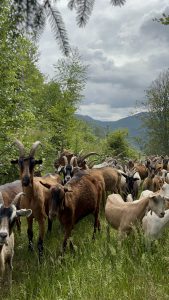
 One highlight I witnessed was the opening of a modern forest pasture in June, where 150 goats were brought to graze in a section of dense forest for three days. Forest grazing was a traditional Black Forest farming practice for centuries before being banned in the 19th century for its toll on the land. However, when practiced in moderation the goats help clear invasive plants, allowing more space and light into the forest. This greatly benefits the species diversity of native insects, flora, and fauna. By integrating the knowledge of both environmentalists and farmers, the Biosphere Reserve and the local town of Utzenfeld have been able to renew the tradition — it was beautiful to see all the happy goats!

What is most rewarding about your internship? 

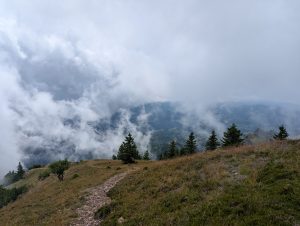
It’s been super rewarding to feel my German improve week by week, especially the moments when I realize I’m able to converse and express myself more naturally! Hiking through the woods to and from work everyday has been similarly rewarding, as it too gets a bit easier each time. Overall, I am inspired by the widely shared commitment to caring for the land here in the Black Forest – ensuring that a mosaic of forest, meadows, pastures and villages over 1000 years old may live and grow together long into the future.