
Name: Theresah Tawiah
Class Year: 2027
Major: History
Minor: Biology, Health Studies
Internship Organization: Bryn Mawr College, Department of Anthropology
Internship Title: Summer Research Assistant
Location: Bryn Mawr, PA
What’s happening at your internship? We would love to hear what kind of work you are doing!
This summer, I have been working with Professor Melissa Pashigian on interdisciplinary research about dizziness. I explore biomedical, historical, and social science literature, organize research findings, and help develop interview and survey questions. My research also examines how dizziness affects people’s everyday lives and how individuals with symptoms that are not always visible seek understanding and legitimacy.
Why did you apply for this internship?
I applied because I wanted to strengthen my research and analytical skills while exploring the relationship between medicine, history, and society. As a History major interested in medical history and public health, this internship allows me to examine a health experience from several perspectives rather than viewing it only as a medical condition.
Was there anything special about how you found this internship?
I found this internship through Professor Melissa Pashigian after taking her classes on illness narratives. Those courses deepened my interest in how people understand and communicate their health experiences, which made this research opportunity especially meaningful to me.
What has been your favorite part of this internship?
My favorite part has been discovering how interdisciplinary research can reveal different sides of the same health experience. I began by examining the medical and historical dimensions of dizziness, but I have especially enjoyed exploring questions about invisible illness, identity, and how people communicate experiences that others may not easily understand.
What is something you have learned from your internship that you didn’t expect?
I did not expect to learn how deeply dizziness can affect a person’s identity, relationships, and everyday life. The internship showed me that dizziness is not only a medical symptom; it can also be an invisible experience that shapes whether people feel heard, understood, and believed.
Working remotely for the first time? What has that experience been like for you?
My internship was hybrid, and on the days I worked remotely, I learned to manage my time, stay organized, and work independently. Regular meetings with Professor Pashigian also gave me opportunities to discuss my findings, ask questions, and receive helpful guidance.
Can you talk about the skills you are learning and why they are important to you?
I am strengthening my literature-search, critical-analysis, and qualitative-research skills. I have learned to use databases such as PubMed, Web of Science, Google Scholar, and Tripod, while organizing sources and findings through Zotero and research databases. I am also learning how to develop thoughtful interview and survey questions that help people describe their experiences in their own words. These skills are important to my future interest in public health because they will help me understand health experiences through both research evidence and patients’ perspectives.
What has been the biggest challenge you have faced at your internship?
The biggest challenge has been finding reliable and accessible sources, especially because research on dizziness spans many disciplines. This taught me to refine my search terms, explore different databases, and make thoughtful decisions about which sources were most relevant.
Can you give us three adjectives and three nouns that describe your internship experience?
Adjectives – Interdisciplinary, Insightful, Rewarding
Nouns – Discovery, Growth, Research
What is most rewarding about your internship?
The most rewarding part has been contributing to research that may help others better understand the experiences of people living with dizziness. I have also enjoyed creating interview and survey questions that allow people to describe their experiences in their own words.
Was this internship what you expected it to be?
The internship went beyond what I expected. I initially expected to focus mainly on the medical and historical aspects of dizziness, but I also explored its social dimensions, including invisible illness, identity and legitimacy.

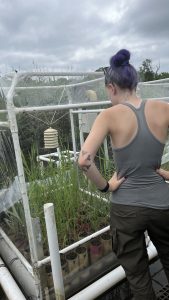
 At the Garten Coop, I am a member of the Anbau (farming) team! Our farm property in Tunsel, which is a community-supported agricultural initiative, grows over 70 varieties of local vegetables using organic and sustainable practices. We work on our farm Tuesdays – Thursdays from 7:30 am to 5:30 pm, and do everything from planting, weeding, and pruning to harvesting for the weekly share of vegetables delivered to families across Freiburg. Every week, over 300 shares of vegetables are harvested at the farm and then transported using an electric van to our transportation hub in the sustainable city district of Vauban.
 What has been your favorite part of this internship?
 We had a painting table with Earth paints we made from different colored soils on our farm, and postcards designed by a local artist to color in. We also harvested wildflowers from the farm property and set up a bouquet-making station. Overall, it was an incredible experience where I got to witness so many beautiful connections being made between community members and our team.

 I work as a gardener in a small-scale local vegetable farm that serves just over 300 households, or about 850 people. The organization is run as a coop, and the farm is run as a small team, the Anbau Team. Every week, they name a different person to be the ‘Team Fairy,’ who is then in charge of organizing the farm tasks. I work on the Anbau team and a committee that helped organize the GartenCoop’s portion of the
 I got to visit Freiburg, Germany, last fall as part of my Climate Change 360 course cluster, and I fell in love with the city. I really liked the ecological focus of the place and wanted to be able to live the sustainable lifestyle I’ve always dreamed of, but is very difficult to achieve in the US. Then, I heard that there was an opening at a vegetable farm. I remember visiting my grandparents’ farm every summer in the mountains of North Carolina, and spending hours wandering their acres of land eating wild berries, and being a menace to their vegetable fields as I picked whatever I pleased and ate whatever I wanted. I have a really complex relationship with food because I have severe food allergies that have dictated my ability to interact with food. As a child, I did not experience food freedom in grocery stores or bakeries, but I was on an equal playing field when I was snacking on fresh berries and vegetables. I have spent my teenage years learning to navigate my allergies in an uneducated world where food is mislabeled, waiters don’t know what cross-contamination is, and food bank programs don’t cater to special dietary needs.
 Food injustice is far beyond access alone; access to SAFE food is a necessity for all. This summer, I wanted to participate in an organization that is working on reforming the food system, and I wanted to make progress in my own food freedom journey while I was working to help others. While the GartenCoop only focuses on small-scale change and pushing for Community-Supported Agriculture, at their core the idea of making fresh produce ecologically sustainable by using a Pay What You Can model is incredible progress for the food injustice movement. Immediately upon hearing about them, I thought that they are a great grassroots model and I want to learn from them so that I can bring this kind of thinking back to the United States.

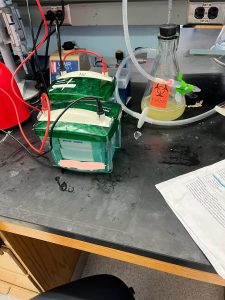
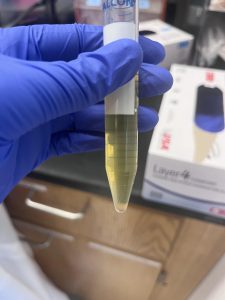
 The Swei lab studies disease ecology. The project that I am working on in the lab is a CDC-funded collaborative project across the country. We are studying the effect of preemptively treating the animals that ticks feed on to lower the rate of Lyme disease transmission. Our section of the project looks at the spread of Lyme disease around the SF Bay Area. We go out into the field and collect ticks. We then take those samples and identify their genus and species with microscopy. Once we have identified their species, we can take Ixodes Pacificus Nymphs (IPAC N) (genus, species, life stage) and extract their DNA. IPAC N are the ticks that can carry Lyme disease, while the nymphal stage is the most likely to have the infection. The extracted DNA is then processed with nested PCR to test for Borrelia burgdorferi, the bacterium that infects the ticks with lyme.
 This internship closely aligns with my interest in disease management and vaccines. After the pandemic, I found myself interested in researching the science behind disease prevention. I was especially interested in this lab because it studies vector-borne diseases transmitted by ticks to humans. A lot of talk about contagious diseases covers ones that are spread from person to person. Lyme disease, however, is not, yet it still is a large problem across the coasts. This internship would also allow me to be close to home this summer.
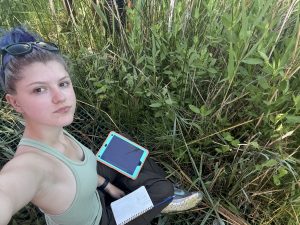
 One thing that surprised me during the internship was the field work. I didn’t know that I was going to be helping with field work as well as in the lab. However, it was a valuable experience. I have gained so much more respect than I already had for people who do field work. In order to collect samples for my lab (tick drags/camera work) one must hike up into the mountains. Then hike OFF of the path and onto steep hill sides in order to better collect samples as that is the area that ticks prefer to live in. Not only is it incredibly physically challenging, it is mentally difficult too. Not many people have ever had the goal of getting ticks on them. In the end I learned that although I may not be cut out for field work I am more capable than I thought.