Semiconductors, Trade Compliance, and La Vie en Rose: Charlotte Kimmerling ’28


Name:
Charlotte Kimmerling
Class Year: 2028
Major: History of Art
Minor:
Museum Studies

Internship Organization: MACOM European Semiconductor Center
Internship Title: Global Trade Compliance Intern
Location: Paris, France

What’s happening at your internship? We would love to hear what kind of work you are doing!

I am working on a variety of projects centered around global trade compliance. This includes reviewing classification records, customs recordkeeping, performing deny party screening, and creating communications both for Global Trade Compliance and in collaboration with the Information Technology team. The Trade Compliance Team at MACOM is relatively new, so they were working on fixing the older customs and classification records in preparation for an audit.

I helped them go back and find misplaced files, or contact DHL and Fedex for the missing records. In addition to this, I worked on three communications projects which are being shared and displayed globally. Each was done in both English and French and centered around education. I worked with Information Technology and Information Security on the content for one, and I worked with Engineers and the other people in Trade Compliance for the other.

Why did you apply for this internship?

I applied to this internship for the opportunity to experience a corporate environment and improve my French. After studying French for six years now, I really wanted to expand my French vocabulary and conversational skills while living in Paris and experiencing French culture. I had done a month abroad in Southern France before my Junior year of High School, and I knew this would be very different. Not only is Paris very culturally different from the south, I would be learning French in a business setting. I also knew that getting some experience working on customs projects and gaining familiarity with export and import law and processes as a History of Art major would be useful for my future career in the art world. 

What has been the biggest challenge you have faced at your internship?

It has been interesting getting used to a corporate environment. Every communication I created had to go through several people before it was ready to be put on the screens around the office, meaning I had to get used to constructive criticism quickly. I was always proud of the end result, and I am glad for the input I received because it ensured the right message got across. By the end, I felt my communication skills improved immensely.

Can you talk about the skills you are learning and why they are important to you?

I have had to do a lot of my own research and I’ve had to figure a lot of things out on my own and through that, I have gained a lot of confidence in my own problem-solving skills. I also feel I have improved upon and developed some practical skills. I have gotten better at writing emails, Microsoft Powerpoint and Excel, and using industry-specific programs like SAP and Agile to perform denied party screening. Working on these different programs for the various projects has shown me the value in being easily adaptable. Before this internship writing emails was very difficult for me, so I am very grateful that I was able to use this opportunity to improve my email skills.

My Summer at The Photo Review: Exploring all Angles by Ella Sokulski ‘27


Name:
Ella Sokulski
Class Year: 2027
Majors: Classical Culture and Society, Classical and Near Eastern Archaeology Minors: Fine Arts, Museum Studies

Internship Organization: The Photo Review
Internship Title: Intern
Location: Langhorne, PA

What’s happening at your internship? We would love to hear what kind of work you are doing!

I started this internship by getting to know the office in Langhorne, and generally exploring the area. I had never really explored that suburb of Philly. I worked on adding new records to the data base at Photo Review, we had just received many photos and I worked to scan and add them into our collection. The Photo Review also has a publication where there is a large listing of all the upcoming photography shows throughout the US. I have been working to prepare for the Sep-Oct edition by updating and finding now shows that are going to be opening in museums and galleries.

Why did you apply for this internship?

I took Intro to Dark Room Photography last semester as Haverford and I really enjoyed my experience, I have continued shooting on my film camera. I asked my professor if he knew of any art related internships for the summer and he pointed me in this direction.

Working remotely for the first time? What has that experience been like for you?

This is my first time working heavily remotely, there are definitely many positives and negatives! I really enjoy being able to choose where I work, I have been able to explore cool cafes around Philly. I also enjoy being able to have the flexibility to travel, especially in the summer. I find that sometimes it is harder to get my questions answered, it is different not to have your boss so readily available. I have had many in-person working and intern experiences so this is definitely expanding my horizons when it comes to work environments and I think it will be super helpful for when I am applying to jobs in the feature, I will know what I like.

Was this internship what you expected it to be?

To be quite honest I was not to sure what this internship was going to be like. It was suggested to me by a professor that I really like so I had high hopes. On the website there was a long list of things the internship could include but I was not too sure what I was actually going to be doing. I was just excited to be working on something creative. It has been a very fun experience so far, I have expanded my skills for how to use databases, which through my many internships I can say with full confidence is one of the most important parts of a functional creative space. I have also been very happy to help with the publication. This is something I had not done before, I have little experience with any sort of magazine and the work that comes with one. Overall, I am happy with the way this internship has been going.

Jadyn Anderson ’28 Interns at Bemis Center for Contemporary Arts


Name:
Jadyn Anderson
Class Year: 2028
Major:  History of Art
Minor: Museum Studies

Internship Organization: Bemis Center for Contemporary Arts
Internship Title: Research Intern
Location: Omaha, NE

What’s happening at your internship? We would love to hear what kind of work you are doing!

This summer, I’ve been digging through Bemis’ physical archives of exhibition catalogues, interorganizational communications, artist records, and more. While I create an inventory of our archive, I’m searching for information about the history of Bemis, such as interesting exhibits, community outreach initiatives, and notable individuals that the gallery has worked with. One of my favorite artists, Hiroshi Sugito, was a Bemis artist in residence in 1996, and I was so excited to find an interesting quote from him in the archive. The gallery’s curator, Rachel Adams, is planning to use the information I find for upcoming projects in celebration of Bemis’ 50th anniversary.

Why did you apply for this internship?

I’ve helped out at Open House Open Studios, an event where our artist-in-residence (AIR) studios are open to the public. Two of this summer’s AIRs have been working on tangible models of botanical drawings.

I was an intern at Bemis last summer where I primarily organized digital records. Though the work I did was in communications rather than with art directly, the gallery environment I was in confirmed my love for, passion for, and desire to work in art spaces. I was thrilled to be accepted back this summer for a museological research role where I could explore my interest in how art spaces influence and interact with their communities.

What is something you have learned from your internship that you didn’t expect?

In my field, I’m interested in the ineffable and ephemeral, what cannot be archived, and rethinking the constraining effects of hypercategorization in museum spaces. I wasn’t sure what task Bemis would assign me this summer, but I certainly wasn’t expecting my role to be so intertwined with these interests. Working with Bemis’ archive has helped me confront the grey area between a demand for systematization and what I consider a necessary shift away from methodologizing art history.

What is most rewarding about your internship?

As I’ve pored over decades of faxes between Bemis and other art spaces, I’ve gathered so much insight about how exhibitions come to be. I’m pursuing a career in curation, and the amount of coordination and collaboration required to put on a show can feel daunting, but I understand the process better now that I’ve seen the behind-the-scenes operations and what timelines tend to look like. I look forward to bringing this insight to my museological studies and future career.

My Time in Austria by Susan Robinson ‘27 


Name: 
Susan Robinson
Class Year:  2027
Major: Anthropology, Minor: Museum Studies
 
Internship Organization: Technisches Museum Wien
Internship Title:  Archival Internship 
Location: Vienna, Austria

What’s happening at your internship? We would love to hear what kind of work you are doing!

This summer, I had the opportunity to intern in the Archives and Conservation Department at the Museum of Science and Technology in Vienna, Austria. It also gave me a behind-the-scenes look at the work that makes museums more than just places to view history, they are places where history is actively preserved. Most of my work focused on protecting historical collections for future generations. I digitized archival documents, photographs, and other historical materials to improve accessibility while reducing the need to handle fragile originals.

I also assisted with preventive conservation by carefully removing metal fasteners, such as staples and paper clips, that can rust over time and damage important records. Although these tasks may seem small, I quickly learned that every detail matters when working with irreplaceable historical materials. Accuracy, patience, and careful documentation are essential parts of ensuring that collections remain available for future researchers.
   
Why did you apply for this internship?

I applied for this internship to gain a global perspective in museum work.

What is something you have learned from your internship that you didn’t expect?

One of the biggest surprises during this internship has been how much care, precision, and documentation are required for every task, even something as simple as removing metal fasteners from historical documents. I also did not realize how much planning goes into preserving both physical and digital collections, including video game materials. I have handled these challenges by paying close attention to detail, asking questions whenever I need clarification, and taking the time to learn the reasoning behind each conservation practice so I can perform my work accurately.

Working alongside archivists and conservation staff has helped me recognize that I enjoy collaborating with professionals who are passionate about preserving history. I have learned that I communicate well, accept constructive feedback, and work carefully as part of a team. Observing experienced staff has also shown me the importance of patience, organization, and shared responsibility when working with fragile and historically significant materials. These relationships have strengthened my confidence and reinforced that I work well in professional museum environments.

Can you talk about the skills you are learning and why they are important to you?

During my internship, I have developed valuable archival and conservation skills, including digitizing historical documents, photographs, and ephemera, handling fragile artifacts using professional preservation standards, and assisting with preventive conservation by removing metal fasteners that could damage materials over time. I have also gained experience maintaining accurate documentation, organizing collections for future research, and learning strategies for preserving digital media.

In addition to these technical skills, I have strengthened my attention to detail, organization, and ability to work responsibly with irreplaceable historical collections. I am making the most of my internship by taking every opportunity to learn from the archivists and conservation staff, asking questions about their techniques, and gaining experience with as many different preservation tasks as possible. Because this is the department I have wanted to work in, I have been fully engaged in every assignment. 

The Strength of the Small: My half year spent at Arch Street Meeting House by Natalie Cincotta ‘26


Name: Natalie Cincotta
Class Year: 2026
Major: Art History
Minor: Museum Studies
 
Internship Organization: Arch Street Meeting House
Internship Title:  Education and Research Intern
Location: Philadelphia, PA
 
What’s happening at your internship? We would love to hear what kind of work you are doing!  

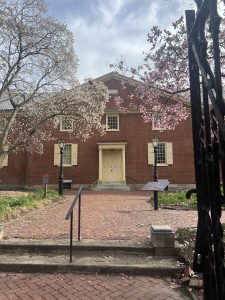
Arch Street Meeting House in the Spring

My internship is unique because it was actually a spring semester internship that I extended into the summer! Over the course of my time there I have witnessed the building going through renovations, the creation of a completely new exhibition space, and the difference between winter and summer operations. I’ve worked on a good number of projects since I started, – Created two education activities for visitors to learn about Quaker history – Learned to manage and added to the new online archive system for the objects collection – Researched and documented a nearly 140 object Quaker family collection – Researched a Quaker signature quilt for a new Exhibit. – Assisted in visitor outreach, 4th of July celebrations, and front desk work. I’ve enjoyed each task for different reasons, but I’m very glad to have had a truly wholistic experience working in a small museum.
 
Why did you apply for this internship?  

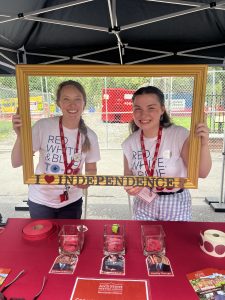
Me and Jennifer Gray at the Red White and Blue To-Do! block party

As an Art History major, I am of course interested in the history and museum functionality of Art. However, I have had a love for all kinds of museums from a very young age. I vividly remember my father taking me and my siblings to small museums and historical houses throughout the Northeast and igniting my interest in local history. I’ve really been able to explore this in my minor in Museum Studies, and through my internship experience. In all honesty, I reached out to Arch Street Meeting house in the spring because I was looking for any museum that would give me an opportunity to intern. While I was eager to work at larger Art institutions, my limited experience in the museum world and Bryn Mawr classes told me that it would be wise to consider small historic places as well. In these museums, with smaller staff, surrounded by physical history, I anticipated receiving a much more intimate understanding of museum basics. I was right, and I couldn’t be happier with where I ended up.
 
What has been your favorite part of this internship? 

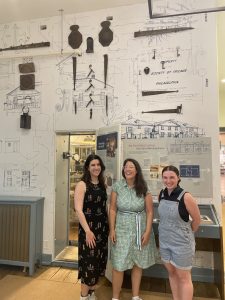
(From left to right) Isabella Dorfman ’17, Elizabeth Tinker ’97, (me) Natalie Cincotta ’26

By far my favorite part of this internship was my experience interacting with the public during the Old City museum’s Red White and Blue To-Do! On July 2nd a collection of smaller museums in the Old City area host a day of music performances, food trucks, a parade and an informational block party. I helped my supervisor Jen during this block party and spoke with the public about Quaker history and Philadelphia. I even used some of my Italian knowledge to speak with a tourist family (shoutout to the Bryn Mawr Italian Department!). I worked on many skillsets this summer, but I think the most challenging to achieve was this confidence to converse with strangers in an educational setting. Learning how to be confident in your own knowledge and share it with others without boring them is an incredibly daunting task. Yet, it became one of my favorite skills to practice. Working on this at my internship has inspired me to look for more public classes at Bryn Mawr, for instance, I have enrolled in an Italian Tri-Co Philly class this fall. 

What is most rewarding about your internship? 

The relationships I’ve formed! If there is one thing that I have found inspiring about my supervisors and co-workers at ASMH, it is their commitment to working in constant collaboration. The team at ASMH is small, so everyone works across multiple departments. While this can be hectic at times, I enjoyed forging relationships with each person that makes the museum work as well as it does. In the same way that I’ve formed connections with my teachers and advisors at Bryn Mawr, I felt it was very easy to reach out to absolutely anyone for assistance. The close-knit community that surrounds ASMH really brings it to life, including the staff, volunteers, visitors, hired contractors, event companies, and even the Quaker friends who meet their every Sunday. Something truly rewarding during the summer months of my internship was the work I did researching an archived quilt for the independent exhibition coordinator who is a Bryn Mawr alum! It was amazing to see how strong the alumni network is in any field of study but especially in Museum work. I give all my thanks to Elizabeth Tinker ‘97 and another Bryn Mawr alum I worked with, Isabella Dorfman ’17 for their support and guidance as I learned how to do exhibition research this summer. I encourage anyone interested in Philadelphia history to come see the new exhibition space at Arch Street Meeting house when it is completed this coming spring! 

Archaeology in Austria: My work with the Vienna Institute of Archaeological Science by Carey Klopfenstein ‘26 


Name: Carey Klopfenstein
Class Year: 2026
Major: Anthropology
Minor: Museum Studies, Classical and Near Eastern Archaeology
 
Internship Organization: Vienna Institute of Archaeological Science
Internship Title:   Intern
Location:  Vienna, Austria
 
What’s happening at your internship? We would love to hear what kind of work you are doing!  

How I set up bones for taking morphometric analysis photos

I’ve been very lucky to do a variety of things at my internship. With one of my supervisors, Dr. Magdalena Blanz, I mainly worked with goose bones from the site of Mühlacker near the ancient Roman city of Carnuntum. I looked through boxes full of bones from the site and identified the tarsometatarsi and humeri of greylag geese. I then took photos of the tarsometatarsi for morphometric analysis. I also worked on cleaning and preparing samples of bone from people from Bronze Age Austria for isotope analysis. During the second part of my work week, I worked with Dr. Birgit Bühler. We worked with metal artifacts from the Avar culture, an early Medieval culture originally from eastern Central Asia that settled in parts of Central Europe. I was privileged enough to be able to see artifacts from the excavations at Zillingtal which have not yet been published. I started out by presorting the artifacts based on the illustrations done at the excavation in the 1980s and learning more about early Medieval metalworking techniques, and then we looked through some of the most promising boxes to check their preservation and which were most promising for analysis.
 
Why did you apply for this internship?  

The site of Carnuntum including reconstructed Roman buildings

Honestly, a big part of the appeal for me was that I would find out whether or not I got in before the deadlines for other summer internship applications, so I wouldn’t have to go through the exhausting process of applying for all the places I was interested in at the same time. I had applied for the IES Vienna Internship funding last summer and didn’t get in, so I wasn’t very hopeful, but I figured if I didn’t apply again I would always regret it and wonder what if. I chose to apply for Vienna specifically because I’m pursuing Museum Studies and there are so many different museums in the city (over 100!) My focus within my major is Archaeological Anthropology, so when I found out that VIAS was willing to interview me I was thrilled.

Was there anything special about how you found this internship?  

The little goose figurine given to me by my supervisor Magdalena Blanz

Because I was doing an IES internship program, I worked with Nika Protic at IES to find an internship to do with the program. Nika was incredibly kind and helpful every step of the way. I wasn’t aware of VIAS before she mentioned them to me.

What has been your favorite part of this internship?  

There were so many parts of my internship that I loved that it’s hard to choose, but I have to say my favorite part has been the people. I’ve tried to take every opportunity I could to meet people in Vienna’s community of archaeological scholars and everyone has been so warm and welcoming. All of my coworkers were such interesting people. Magdalena’s office is filled with a lush forest of plants and she collects little animal figurines. She’s also part of a brass quintet. Birgit does horseback archery, learned to read Ogham, the ancient Irish script, and travels to watch Orcas. I had so many wonderful conversations both about archaeology and about people’s lives. On my last day, Magdalena gave me a little goose figurine to commemorate my work on the goose bones and I was really touched.     

What is something you have learned from your internship that you didn’t expect?  

I wasn’t expecting just how long Austria has been a diverse place and the role of cultural identity. Even before the Roman conquest, Iron Age Austrians had access to far reaching trade routes. Roman sites such as Carnuntum and Vindobona (where Vienna now stands) were places of interactions between Romans and Celtic peoples. Under Avar rule, genetic evidence suggests that groups of people of various European groups adopted Avar cultural practices. On the other end the remains of a woman have been found which genetic analysis indicates that her ancestry was from modern day Mongolia, but her dress and burial indicate that presented, and perhaps identified, herself, with the culture of the Roman province of Pannonia. I didn’t know that much about ancient and Medieval Austria before this summer, and I was fascinated by the rich history of different cultures and their interactions here. Also, there is a type of Avar earring called a Bommel, a German word for the pompoms on top of winter hats, which I thought was very cute. 

Can you talk about the skills you are learning and why they are important to you? 

I wasn’t expecting just how long Austria has been a diverse place and the role of cultural identity. Even before the Roman conquest, Iron Age Austrians had access to far reaching trade routes. Roman sites such as Carnuntum and Vindobona (where Vienna now stands) were places of interactions between Romans and Celtic peoples. Under Avar rule, genetic evidence suggests that groups of people of various European groups adopted Avar cultural practices. On the other end the remains of a woman have been found which genetic analysis indicates that her ancestry was from modern day Mongolia, but her dress and burial indicate that presented, and perhaps identified, herself, with the culture of the Roman province of Pannonia. I didn’t know that much about ancient and Medieval Austria before this summer, and I was fascinated by the rich history of different cultures and their interactions here. Also, there is a type of Avar earring called a Bommel, a German word for the pompoms on top of winter hats, which I thought was very cute. 

Can you give us three adjectives and three nouns that describe your internship experience? 

Enriching, welcoming, enlightening  

Practice, gecrets (geese secrets),  bommels  

What is most rewarding about your internship?  

My supervisors talked a lot about how much the stuff I was doing was helping them, and I was really happy to be helping them out. I also found it incredibly cool to be face to face and handling artifacts. Unfortunately, because they’re unpublished, I can’t include images of the Avar metal artifacts, but some of them were incredibly beautiful and well preserved, and I could hardly believe that I was right there holding them. 

Was the internship what you expected it to be? 

I would say that this internship exceeded my expectations. I was excited going into it, but my expectations were vague and I was really happy with how it turned out. 
Laurel Gabbard ’26 Works in the Archives in Santiago, Chile!


Name: Laurel Gabbard
Class Year: 2026
Majors: History of Art, Spanish
Minor: Museum Studies
 
Internship Organization:  Archivos de la Facultad de Artes en la Pontificia Universidad Católica de Chile
Internship Title:   Archives Intern
Location:  Santiago, Chile
 
What’s happening at your internship? We would love to hear what kind of work you are doing!  

Pontificia Universidad Católica de Chile

This summer, I have been interning in Santiago, Chile, working in the archives of the School of Arts at the Pontificia Universidad Católica de Chile. As an intern working in the theater archives, I have been introduced to a wide array of archival materials, including but not limited to documentary footage, interviews, photos, letters, posters, and theater programs. My main task consisted of transcribing, subtitling, and translating three documentaries that focus on different elements of Chilean theatrical history, all of which, in some capacity, focused on theater as a revolutionary act that can operate as a push against state power and dictatorship. I also transcribed interviews conducted with Alberto Kurapel and Susana Cáceres, Chileans living in exile in Canada during the dictatorship, and who, in their time in Montreal, formed a theater company that produced acts based on their own experiences in political exile. I also had the chance to meet with the subject of one of the documentaries, Jacqueline Roumeau, the founder of an organization that coordinates theater, and more broadly, art opportunities, within prisons as an act of rehabilitation and reintroduction into society after incarceration. My supervisor recently presented the three documentaries that I subtitled at a three-day long event at the Chilean embassy in Buenos Aires, Argentina, and knowing that I contributed to the accessibility and understanding of these visual archives is very exciting!
 
Why did you apply for this internship?  

Digital Humanities Lab

I originally applied for the IES Abroad summer internship program, along with Career and Civic Engagement funding knowing that I wanted the opportunity to live and work in a Spanish-speaking country and get more comfortable with my professional abilities in my second language. As I worked with IES to find an internship placement, I knew I wanted to be in the arts and humanities sector, so when I was presented with the opportunity to interview for a position in the archives of the School of Arts, I knew that would receive the guidance and experience I was looking for!
 

What has been your favorite part of this internship?  

My favorite part of this internship, besides the professional experience I have gained, has been getting to know my coworkers and supervisors, and in doing so, gain insight not only into professional life in Chile, but also being able to learn tons about Chilean culture, history, social issues, and be a part of the day to day office conversations! My coworkers, in addition to other university-age interns at the office all welcomed me with open arms and helped me learn tons about what it is like to be young in Chile, and I feel very lucky to have had this experience of full linguistic and social immersion in addition to my professional experience.   

What is something you have learned from your internship that you didn’t expect? 

Coworkers and I on my last day!

As a history of art major, I came into this internship with a lot of knowledge about art history, but less about theater and performance art as archival materials. I have been able to learn a lot about the way that archives can preserve the history and memory of works of art and performance that are less tangible and more fleeting. In this case, it has to do with the way that the archives at my internship hold onto the memory of Chilean theater, although one can never experience the exact moment of the production in the same way again. The collections of videos, audios, interviews, pamphlets, posters, and other mediums that the theater archives hold has pushed me to reconceptualize my understanding of what forms of art are easily “archivable”. As I prepare to begin my senior thesis this coming year, I have been considering the way that the corporeality and tangibility, or lack thereof, of performance art can be catalogued and remembered, and how our perceptions of history and memory are changed by how we register art as a physical or non-physical item. I did not go into my internship expecting that something that falls into the realm of theater performance could be so related to what I may want to write my thesis on, but I feel lucky to have had this experience and open my mind to a new realm of critical thinking in the field of art history!