Name: Sophonisba Franecki
Class Year: 2026
Major: Comparative Literature, Geology
Internship Organization: Exilarte Center for Banned Music
Internship Title: Archive Intern, “Haus- und Hoflektor”
Location: Vienna, Austria
What’s happening at your internship? We would love to hear what kind of work you are doing!
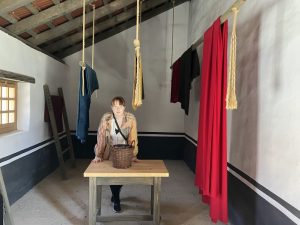
The Wellesz piano, with whom I and my coworker Nobuko shared an office. Photographed by Iby Jolande Varga, who lays out and prints all of Exilarte’s publications, including the history I wrote during my internship
I’m working for Exilarte Center for Banned Music, an archive within the MDW (University of Music and Performing Arts Vienna) dedicated to composers and musicians who were persecuted by the Nazi regime. It started two decades ago as a nonprofit pet project of Prof. Gerold Gruber. Since then, Exilarte has transformed into an archive where performers and researchers can study the estates of artists like the composer Erich Wolfgang Korngold, the violinist Fritz Kreisler and the world-renowed tenor-soprano pair, Jan Kiepura and Marta Eggerth. The center also curates exhibits, publishes books and hosts concerts, so that the composers whose careers were cut short by a hostile regime can recover their place in the world of classical music.
Since the Exilarte’s birthday is coming up in 2026, I was tasked with writing a history of Exilarte Center. To prepare, I visited the archives, combed through the massive database of all events held by Exilarte since 2006 – the first one was a concert dedicated to the violinist Alma Rosé and conducted interviews with Exilarte Center’s major professional collaborators. That’s how I’ve met Ulrike Anton, flautist and head of Vienna’s Schoenberg Center, soprano Josipa Bainac Hausknecht, and documentarian Stefan Herzog. The fruit of the summer is an 84-page booklet that chronicles not only the story of the center itself, but the century of people who created it.
Why did you apply for this internship?
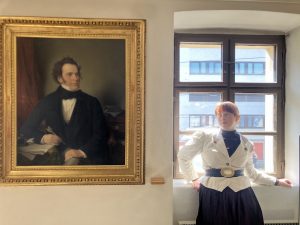
Reconnecting with Schubert
I found out about Exilarte through Bryn Mawr’s IES Abroad International Internship Fund, which also provided me with a stipend for my time in Vienna. What drew me in, though, was the opportunity to conduct archival research and explore my ongoing interests in narrative history and the so-called classical “canon.” In a creative writing class my freshman year at Bryn Mawr, I’d written a play about the Congress of Vienna and a fictionalized meeting between the teenage Franz Schubert and his idol, Ludwig van Beethoven. Even before then, I’d been interested in questions like: who decides what events and narratives are recorded as history? What role does art, especially temporally-bound forms of art like music, have to with that process? And how do you even begin to explain the interactions between a human being, the work they create and the world that creates them?
It’s a very interdisciplinary question. I’ve joked before that I don’t have the discipline to be a historian, but even with my double major I find myself drawn again and again to projects that combine scholarly approaches, and that mediate between real or imagined pasts and the present upon which they ineluctably bear. Working for Exilarte gave me the opportunity to develop that practice, as well as to utilize the other professional competencies necessary in the modern world.
What is something you have learned that you didn’t expect?
I didn’t expect to fall in love with the dramaturg Marcel Prawy (1911-2003). While I was researching Eggerth and Kiepura, I happened upon the biography of Kiepura’s personal secretary, who traveled with the couple to New York in 1938 and came back with the US Army in 1946. He’s a figure known much more widely in Austria today than in the United States, but in his life time he was a cultural mediator between his home and adopted countries. He was a friend of Leonard Bernstein, and while he’s a very avid self-promoter, his claim that he brought the American musical form to the Viennese theater scene has turned out to hold water. He translated Kiss Me, Kate and West Side Story and, as the dramaturg of the Wiener Volksoper, oversaw their Vienna premieres. It’s a legacy that continues to facilitate cultural exchange; this fall, there will be a performance of Prawy’s translation at the Volksoper led by choreographer Bryan Arias.
The international reach of Exilarte’s projects is both deliberate and unfortunate: unfortunate, because it’s the mortal threat of a hostile state that forces artists to flee, but deliberate because the new surroundings they find themselves in often transform their music, and lead to cultural exchange. Prawy’s case is that of a passionate amateur’s recently-barred lawyer with an irrepressible passion for opera – who, in American exile, turns his passion into a profession and facilitates a revolution in theater practices. Discovering his story, and being able to present it to an international readership, has been especially rewarding, because it mirrors the work I’m doing today and hope to continue with in the future.
What is most rewarding about your internship?
The combination of Austrian workplace culture and the genuine passion everyone in the team has for the Center’s mission. Mandatory PTO and sick days have normalized a deeper respect for work-life balance than is prevalent in the United States, and because Exilarte’s team is – six people, not counting any professionals visiting the archive that day – everything is planned in a very respectful, consensus-driven manner. One of my interviewees said that we were “Feuer und Flamme” for these composers and their stories, and that’s more or less true. We all care about music, we care about preserving human life against the dehumanizing vicissitudes of history, and we show we care about that project by respecting each other’s humanity and the dignity of our shared working environment. That is, in the words of the composer Erich Wolfgang Korngold, “Glück, das mir verblieb”; a (good) fortune that’s remained with me.