A Summer of Growth: My Internship at the Municipality of Quinta Normal by Jacqueline Espinoza ‘26


Name: Jacqueline Espinoza
Class Year: 2026
Major: Sociology
Minor: Health Studies

Internship Organization: Municipalidad de Quinta Normal SECPLAN
Internship Title:  Projects Team Intern
LocationSantiago, Chile

What’s happening at your internship? We would love to hear what kind of work you are doing!  
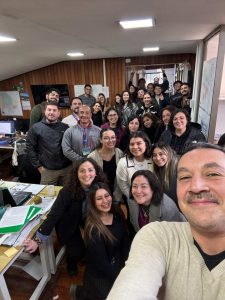
This summer, I was fortunate enough to complete an internship at the Municipalidad de Quinta Normal, a local government office that works closely with the mayor and city council to address the evolving needs of the community and guide the municipality’s development. The office plays a vital role in planning, budgeting, and executing public projects aimed at improving the quality of life for residents. My specific placement was within the urban development team, where I gained hands-on experience working on a variety of initiatives that focused on the physical and social growth of local neighborhoods. Throughout the summer, I collaborated closely with the projects team on several community-based initiatives. Our work involved engaging directly with residents to better understand their concerns, priorities, and hopes for the future of their neighborhoods. We were responsible for drafting detailed proposals aimed at securing government or external funding, ensuring that these proposals accurately reflected community voices and had the necessary public support to move forward. I personally contributed by designing visual aids such as graphs and charts, writing key proposal sections, and participating and holding public forums and neighborhood meetings to collect meaningful input from residents of the community.

Why did you apply for this internship? 
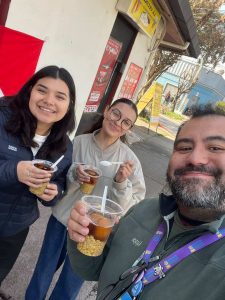
I applied for this internship because I wanted to explore the different career paths that sociologists can take beyond academia. I was especially interested in seeing how sociology can be applied in real-world settings to make an impact. I was drawn to positions that work directly with the community, roles where you’re not just studying people from a distance, but actually engaging with them, listening to their experiences, and understanding their needs firsthand. I wanted to be part of a team that collaborates with communities to identify meaningful solutions, rather than simply analyzing data from afar. This internship felt like the perfect opportunity to connect my academic interests with practical, community-focused work.

What has been your favorite part of this internship? 
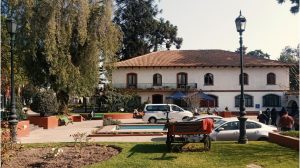
One of the most meaningful parts of my internship was the people, both my coworkers and the community members I worked with. Every day when I arrived at the office, I was greeted with warmth and friendliness by my coworkers. From the very beginning, they made me feel welcome and helped me integrate into Chilean culture in a way that felt natural and genuine. They patiently taught me about the language, shared insights into Chilean society, and introduced me to local customs. We went out to eat traditional Chilean dishes, and they shared their favorite music, films, and stories with me, which deepened my appreciation for the culture and made me feel more connected to the place I was living in. But beyond the office, the most powerful moments came from engaging with the community. Meeting people face-to-face, listening to their experiences, and understanding their needs reminded me why I chose to study sociology in the first place. These conversations made it clear to me that I want a career centered on helping others, not in a distant way, but by being present, listening deeply, and working alongside people to create real change. Seeing their smiles, hearing their stories, and knowing they felt heard and valued was incredibly rewarding. Those interactions weren’t just the highlight of my internship, they reaffirmed my purpose.

What is most rewarding about your internship? 

The most rewarding part of my internship came toward the end, when I was finally able to step back and see all the pieces come together, the planning, the conversations, the proposals, and realize that we had contributed to real, tangible change in the community. In the beginning, it all seemed so simple. Someone would walk into our office with a request, maybe to rebuild a park or renovate a plaza that had fallen into disrepair. At first glance, it might seem like a small ask, but what I came to understand is that these spaces hold deep meaning for people. They’re places where families gather, children play, and neighbors connect. When those spaces aren’t accessible or safe, it affects daily life more than most people realize. Once a request was made, the process would begin. My team and I would meet with residents, listen to their concerns and ideas, and begin crafting a proposal that reflected the community’s vision. There were moments of uncertainty, slow progress, and lots of coordination, but each step brought us closer to a shared goal. Being part of that journey, from the very first conversation to the finalized project, taught me so much about how lasting change really happens. It’s collaborative, it’s slow at times, but it’s deeply meaningful. By the end of the internship, when I saw a space transformed and the community’s joy at having something built with them rather than for them, it hit me just how impactful this kind of work can be. It wasn’t just about construction or urban design, it was about trust, voice, and inclusion. Watching people use and enjoy a space they had a hand in shaping reminded me why I’m passionate about community-centered work. That sense of fulfillment, of knowing I played a small part in something bigger, is something I’ll carry with me for a long time. 
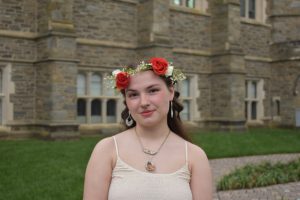
The Strength of the Small: My half year spent at Arch Street Meeting House by Natalie Cincotta ‘26


Name: Natalie Cincotta
Class Year: 2026
Major: Art History
Minor: Museum Studies

Internship Organization: Arch Street Meeting House
Internship Title:  Education and Research Intern
Location: Philadelphia, PA

What’s happening at your internship? We would love to hear what kind of work you are doing!  

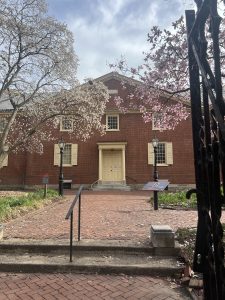
Arch Street Meeting House in the Spring

My internship is unique because it was actually a spring semester internship that I extended into the summer! Over the course of my time there I have witnessed the building going through renovations, the creation of a completely new exhibition space, and the difference between winter and summer operations. I’ve worked on a good number of projects since I started, – Created two education activities for visitors to learn about Quaker history – Learned to manage and added to the new online archive system for the objects collection – Researched and documented a nearly 140 object Quaker family collection – Researched a Quaker signature quilt for a new Exhibit. – Assisted in visitor outreach, 4th of July celebrations, and front desk work. I’ve enjoyed each task for different reasons, but I’m very glad to have had a truly wholistic experience working in a small museum.

Why did you apply for this internship?  

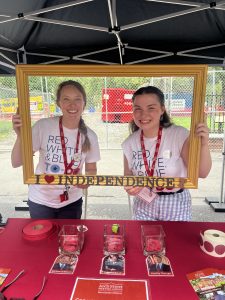
Me and Jennifer Gray at the Red White and Blue To-Do! block party

As an Art History major, I am of course interested in the history and museum functionality of Art. However, I have had a love for all kinds of museums from a very young age. I vividly remember my father taking me and my siblings to small museums and historical houses throughout the Northeast and igniting my interest in local history. I’ve really been able to explore this in my minor in Museum Studies, and through my internship experience. In all honesty, I reached out to Arch Street Meeting house in the spring because I was looking for any museum that would give me an opportunity to intern. While I was eager to work at larger Art institutions, my limited experience in the museum world and Bryn Mawr classes told me that it would be wise to consider small historic places as well. In these museums, with smaller staff, surrounded by physical history, I anticipated receiving a much more intimate understanding of museum basics. I was right, and I couldn’t be happier with where I ended up.

What has been your favorite part of this internship?

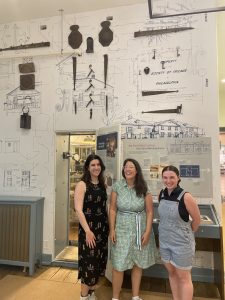
(From left to right) Isabella Dorfman ’17, Elizabeth Tinker ’97, (me) Natalie Cincotta ’26

By far my favorite part of this internship was my experience interacting with the public during the Old City museum’s Red White and Blue To-Do! On July 2nd a collection of smaller museums in the Old City area host a day of music performances, food trucks, a parade and an informational block party. I helped my supervisor Jen during this block party and spoke with the public about Quaker history and Philadelphia. I even used some of my Italian knowledge to speak with a tourist family (shoutout to the Bryn Mawr Italian Department!). I worked on many skillsets this summer, but I think the most challenging to achieve was this confidence to converse with strangers in an educational setting. Learning how to be confident in your own knowledge and share it with others without boring them is an incredibly daunting task. Yet, it became one of my favorite skills to practice. Working on this at my internship has inspired me to look for more public classes at Bryn Mawr, for instance, I have enrolled in an Italian Tri-Co Philly class this fall. 

What is most rewarding about your internship? 

The relationships I’ve formed! If there is one thing that I have found inspiring about my supervisors and co-workers at ASMH, it is their commitment to working in constant collaboration. The team at ASMH is small, so everyone works across multiple departments. While this can be hectic at times, I enjoyed forging relationships with each person that makes the museum work as well as it does. In the same way that I’ve formed connections with my teachers and advisors at Bryn Mawr, I felt it was very easy to reach out to absolutely anyone for assistance. The close-knit community that surrounds ASMH really brings it to life, including the staff, volunteers, visitors, hired contractors, event companies, and even the Quaker friends who meet their every Sunday. Something truly rewarding during the summer months of my internship was the work I did researching an archived quilt for the independent exhibition coordinator who is a Bryn Mawr alum! It was amazing to see how strong the alumni network is in any field of study but especially in Museum work. I give all my thanks to Elizabeth Tinker ‘97 and another Bryn Mawr alum I worked with, Isabella Dorfman ’17 for their support and guidance as I learned how to do exhibition research this summer. I encourage anyone interested in Philadelphia history to come see the new exhibition space at Arch Street Meeting house when it is completed this coming spring! 

Sophonisba Franecki ’26 Makes Music History in Vienna

Name: Sophonisba Franecki
Class Year: 2026
Major: Comparative Literature, Geology 

Internship Organization: Exilarte Center for Banned Music
Internship Title:  Archive Intern, “Haus- und Hoflektor”
Location: Vienna, Austria 

What’s happening at your internship? We would love to hear what kind of work you are doing! 

The Wellesz piano, with whom I and my coworker Nobuko shared an office. Photographed by Iby Jolande Varga, who lays out and prints all of Exilarte’s publications, including the history I wrote during my internship

I’m working for Exilarte Center for Banned Music, an archive within the MDW (University of Music and Performing Arts Vienna) dedicated to composers and musicians who were persecuted by the Nazi regime. It started two decades ago as a nonprofit pet project of Prof. Gerold Gruber. Since then, Exilarte has transformed into an archive where performers and researchers can study the estates of artists like the composer Erich Wolfgang Korngold,  the violinist Fritz Kreisler and the world-renowed tenor-soprano pair, Jan Kiepura and Marta Eggerth. The center also curates exhibits, publishes books and hosts concerts, so that the composers whose careers were cut short by a hostile regime can recover their place in the world of classical music. 

Since the Exilarte’s birthday is coming up in 2026, I was tasked with writing a history of Exilarte Center. To prepare, I visited the archives, combed through the massive database of all events held by Exilarte since 2006 – the first one was a concert dedicated to the violinist Alma Rosé and conducted interviews with Exilarte Center’s major professional collaborators. That’s how I’ve met Ulrike Anton, flautist and head of Vienna’s Schoenberg Center, soprano Josipa Bainac Hausknecht, and documentarian Stefan Herzog. The fruit of the summer is an 84-page booklet that chronicles not only the story of the center itself, but the century of people who created it.  

Why did you apply for this internship?  

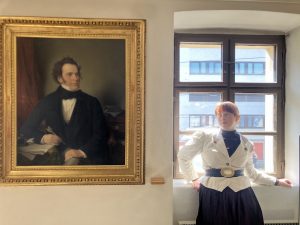
Reconnecting with Schubert

I found out about Exilarte through Bryn Mawr’s IES Abroad International Internship Fund, which also provided me with a stipend for my time in Vienna. What drew me in, though, was the opportunity to conduct archival research and explore my ongoing interests in narrative history and the so-called classical “canon.” In a creative writing class my freshman year at Bryn Mawr, I’d written a play about the Congress of Vienna and a fictionalized meeting between the teenage Franz Schubert and his idol, Ludwig van Beethoven. Even before then, I’d been interested in questions like: who decides what events and narratives are recorded as history? What role does art, especially temporally-bound forms of art like music, have to with that process? And how do you even begin to explain the interactions between a human being, the work they create and the world that creates them? 

It’s a very interdisciplinary question. I’ve joked before that I don’t have the discipline to be a historian, but even with my double major I find myself drawn again and again to projects that combine scholarly approaches, and that mediate between real or imagined pasts and the present upon which they ineluctably bear. Working for Exilarte gave me the opportunity to develop that practice, as well as to utilize the other professional competencies necessary in the modern world. 

What is something you have learned that you didn’t expect? 

I didn’t expect to fall in love with the dramaturg Marcel Prawy (1911-2003). While I was researching Eggerth and Kiepura, I happened upon the biography of Kiepura’s personal secretary, who traveled with the couple to New York in 1938 and came back with the US Army in 1946. He’s a figure known much more widely in Austria today than in the United States, but in his life time he was a cultural mediator between his home and adopted countries. He was a friend of Leonard Bernstein, and while he’s a very avid self-promoter, his claim that he brought the American musical form to the Viennese theater scene has turned out to hold water. He translated Kiss Me, Kate and West Side Story and, as the dramaturg of the Wiener Volksoper, oversaw their Vienna premieres. It’s a legacy that continues to facilitate cultural exchange; this fall, there will be a performance of Prawy’s translation at the Volksoper led by choreographer Bryan Arias. 

The international reach of Exilarte’s projects is both deliberate and unfortunate: unfortunate, because it’s the mortal threat of a hostile state that forces artists to flee, but deliberate because the new surroundings they find themselves in often transform their music, and lead to cultural exchange. Prawy’s case is that of a passionate amateur’s recently-barred lawyer with an irrepressible passion for opera – who, in American exile, turns his passion into a profession and facilitates a revolution in theater practices. Discovering his story, and being able to present it to an international readership, has been especially rewarding, because it mirrors the work I’m doing today and hope to continue with in the future.  

What is most rewarding about your internship? 

The combination of Austrian workplace culture and the genuine passion everyone in the team has for the Center’s mission. Mandatory PTO and sick days have normalized a deeper respect for work-life balance than is prevalent in the United States, and because Exilarte’s team is – six people, not counting any professionals visiting the archive that day – everything is planned in a very respectful, consensus-driven manner. One of my interviewees said that we were “Feuer und Flamme” for these composers and their stories, and that’s more or less true. We all care about music, we care about preserving human life against the dehumanizing vicissitudes of history, and we show we care about that project by respecting each other’s humanity and the dignity of our shared working environment. That is, in the words of the composer Erich Wolfgang Korngold, “Glück, das mir verblieb”; a (good) fortune that’s remained with me. 

Emily Lu ’27 Explores a Summer in Web Development 

Name: Emily Lu
Class Year: 2027
Major: Mathematics

Internship OrganizationFocus Technology
Internship Title:   Software Engineer Intern
LocationNanjing, China

What’s happening at your internship? We would love to hear what kind of work you are doing! 

At Focus Technology, I worked as a front-end intern on a real-world enterprise-level content editing platform. My tasks involved designing and debugging modular page blocks while also editing Freemarker-based templates and fine-tuning UI styles. One of the projects I contributed to was a dynamic product categorization and display component, where I helped troubleshoot layout issues and enhance user interaction. I collaborated closely with design and backend teams, participated in daily stand-ups, and learned to write cleaner, production-ready code

Why did you apply for this internship?  

I was interested in deepening my practical development skills beyond coursework. I was also drawn to their international e-commerce platform and wanted to see how enterprise-level web products are managed and scaled.

Can you talk about the skills you are learning and why they are important to you? 

This internship strengthened both my technical and communication skills. I became more confident using developer tools, navigating complex codebases, and refactoring components for better maintainability. On the soft skills side, I learned how to ask effective questions when I was stuck and how to write progress updates that made sense to team members from non-technical backgrounds. These are essential skills for any future role I take on—especially in collaborative development environments.

Can you give us three adjectives and three nouns that describe your internship experience?

Adjectives: Practical, Challenging, Rewarding  

Nouns: Codebase, Teamwork, Growth 

Daniella Jacob ’26: My Time in Chile, the Shapeshifting Country 


Name
: Daniella Jacob
Class Year: 2026
Major: Religion, Anthropology

Internship OrganizationWatgen SpA
Internship Title:   Acquisitions Intern
LocationSantiago, Chile

What’s happening at your internship? We would love to hear what kind of work you are doing!  

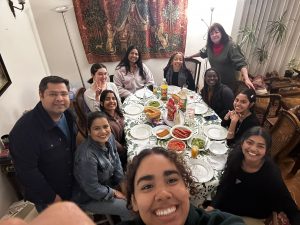
Goodbye dinner including my friends, host mom, family friends, and a Chilean traditional dish (completos)

As my internship, I have been working at WatGen Solar Energy. Watgen is part of a government initiative called StartUp Chile. StartUp Chile is an organization that gave funding to a handful of Chilean startups that are traillazing the technology sphere. WatGen was one of the special startups that were selected. My responsibilities included reaching out to clients and aquiring new investors. This was a new muscle that this internship helped me develop, since I had never done anything in the technology industry before. To inform potential clients of what they were buying into, I had to fully understand the industry and the economic state of Chile in comparison to other countries. Also, as part of my job, I got to work with local tribal leaders and municipalities to help them understand how our services could be of use to them as well. My favorite part of the internship overall was the work environment. We worked in a building that was in the heart of Santiago. All of the startups sponsored by StartUp Chile worked on one floor. It was incredible to literally work at the same table as the most intelligent, creative, generative minds in the country. Young professionals around me would be working hard for eight hours, refilling their yerba mate cups (a cultural caffeine drink) over and over. I learned a lot from their work ethic and developed close relationships with two of my coworkers just from working alongside each other.

Why did you apply for this internship? 

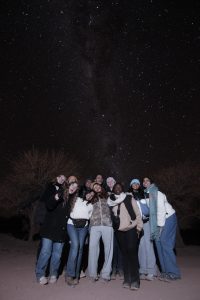
Stargazing trip in the desert with a full view of the Milky Way

When I applied to IES Abroad Santiago, I had felt that my resume was pretty cushioned. I had interned the past two summers and had worked all throughout my three years of college as well. One huge gap I was noticing in my resume is that I lacked any experience abroad. I had witnessed many friends coming back from their time abroad mentioning how it was truly “life-changing.” I had heard that word over and over. So, I decided my last summer in college that I really wanted to go abroad and experience that perspective-shift that others had. There were other locations available for IES but I wanted to prioritize going to a place that was vastly different from the life I was used to. Europe and the global West has cultural differences but share more similarities to the U.S. than differences, arguably. I also wanted to challenge myself to be immersed in a different language, with no option to cop-out and use English. That certainly made my experience more difficult but I left the city having my taxi driver shocked that I knew so much Spanish as an American.

What has been the biggest challenge you have faced at your internship? 

One challenge I had with my internship in Santiago is that I felt like I was not very useful. WatGen was not actually the internship I had agreed upon when I first came to Santiago. I worked at a nonprofit my first two weeks in Santiago and was working on children’s rights and marketing. I grew dissatisfied in the internship because it resembled work I had done years ago. I felt like it was not helping me make professional progress and wouldn’t offer me new skills. So, I met with the IES staff and discussed new options. That is when I interviewed for WatGen and got chosen as an intern. It was difficult to advocate for myself in this case, knowing that it was late in the recruiting cycle and that my options were limited. It was also difficult to communicate clearly why I was so adamant on getting a switch, especially because the workplace culture in Santiago is not as cut-throat and intense as I was used to in the States. But, once I became insistent on what I knew was right for my professional progress, I was given an opportunity to work in a place that taught me new skills and developed my resume in a field that is increasingly relevant.

Was this internship what you expected it to be?

My internship took a learning curve to be fully comfortable. The workplace culture in Santiago, as I mentioned before, feels radically different than what I am used to (especially if you are familiar with corporate America). For example, many of the students’ bosses in the program would sometimes not come in office although we were expecting them. Also, bosses may assign tasks with low-context behind the assignment. This was especially a problem I faced: me and my co-worker would be given complex assignments but not quite know the why, how, or who behind our tasks. This taught me to be very direct and assertive in communicating. Instead of wallowing in confusion, I learned to immediately contact my boss with my questions in curiosities so I don’t waste the company’s time or stress myself out. This internship is really what I made of it! Advocating for myself more than usual definitely was a learning curve but it taught me unexpected communication skills that were honestly lacking before this internship. I am grateful for that.  

Aimee Crozat ’27 Interns with Cities Professor


Name
: Aimee Crozat
Class Year: 2027
Major: Growth and Structure of Cities
Minor: Literatures in English

Internship OrganizationBryn Mawr Humanities & Social Sciences Research Program
Internship Title:   Summer Research Intern
LocationBryn Mawr, PA

What’s happening at your internship? We would love to hear what kind of work you are doing! 

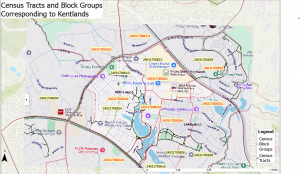
A map I made in ArcGISPro showing project boundaries in relation to census tracts and block groups, to aid with data collection

I am working as a research intern with Professor Hurley in the Growth and Structure of Cities department. I am helping with her research project, “Oral Histories of New Urbanism.” As part of this, I am conducting interviews with professionals who were involved in the early years of New Urbanism, which was an urban planning movement that began in the 1980s focused on creating dense, walkable communities. I am also compiling data on numerous new urbanist developments, and writing literature reviews centered around New Urbanism and how best to measure success in the context of urban planning. Additionally, I have been using GIS to create maps that show development boundaries in relation to block group and census tract boundaries. She is still in the early stages of the project, which has allowed me a lot of creativity in what I want to work on and the best ways to help gather data.

Why did you apply for this internship? 

I took Urban Culture and Society with Professor Hurley and Professor Restrepo last fall semester, and when I saw that Professor Hurley needed a summer intern, I thought it would be the perfect way to combine my majors of Growth and Structure of Cities and Literatures in English. Her research project sounded so interesting that after doing a deep dive into New Urbanism, I knew I had to apply.

Can you talk about the skills you are learning and why they are important to you? 

I have been able to use this summer as an opportunity to develop a multitude of skills! Since beginning the summer, I have developed my abilities in ArcGISPro and Zotero, and I have become proficient in Microsoft Excel. I’ve also gained experience in conducting and transcribing oral history interviews. Later in the summer, I should have the opportunity to learn NVivo, which is a qualitative analysis software that analyzes the data I’ve been collecting from interviews. Being able to pick up skills quickly is something that will hopefully come in handy, and I’m glad I was able to cultivate that this summer. 

What is most rewarding about your internship?   

The most rewarding part of this internship for me has been the ability to dive into the academic topics that I find interesting without the stress of being graded. I meet with Professor Hurley once a week, but almost all of the work I do is alone, meaning that I can work on my own schedule and at my own pace. If I don’t understand something, I can table it to ask about later and work on something else in the meantime. This has allowed me to learn qualitative and quantitative skills without fear that I’m doing something “incorrectly”. I have also been able to follow my passions within Cities: I took Intro to GIS last semester, and when I asked if I could incorporate those skills and create maps to aid with the research project, I was met with enthusiasm.

Working From Home: My Time at the Jacksonville’s Mayor’s Office by Dalia Ibrahim ‘27 


Name
: Dalia Ibrahim
Class Year: 2027
Major: Growth and Structure of Cities
Minor: Data Science

Internship Organization
Internship Title:   Mayor’s Office Intern – Office of Civic Engagement and Youth Participation
LocationJacksonville, FL

What’s happening at your internship? We would love to hear what kind of work you are doing!  

Civil Rights Trail Photoshoot

During my internship, I’ve been involved in several impactful projects. One of those projects has been applying for Jacksonville to become designated as a Civil Rights Trail City and completing the formal application process, cold-calling for endorsements and letters of support, and ensuring the application is up to the requirements and standards. Given Jacksonville’s history, I was surprised to find it hadn’t already received this designation. I’ve also undertaken research on redlining in Jacksonville and conducted interviews with a diverse group of individuals who are advocating for justice. These interviews included voices from various backgrounds, including pastors, activists, and community planners. I have also been involved in collaborating with departments and organizations like the Neighborhoods Department, and the Jacksonville Run Club. I’ve also represented our branch at workshops and youth career fairs. Our main focus is on engaging youth aged 16-23, ensuring their voices are amplified and that they feel included in our initiatives. A few other projects I’m currently working on include What Young People Want, State of the Union, Debates, the YES Summit, our Volunteer Program, research for the Mayor’s Town Hall, and the Legacy Project

Why did you apply for this internship?  

At Youth Career Fair

Last summer, I was a Historic Preservation Intern at Riverside Avondale Preservation, which sparked my desire to explore new opportunities so I was avidly willing to branch out to work at a different level. I applied for this internship because I wanted to obtain a first-hand experience in a government-entry level job within a major city. I was excited for a unique opportunity to gain a solid grasp of the inner workings of the Mayor’s Office and its approach to community matters. Jacksonville is unique in that it is the largest city in the United States by landmass and has a total population of 1 million; Jacksonville is a hub to a plethora of communities that I was eager to represent and work with, and have been proud to be a part of.

Can you give us three adjectives and three nouns that describe your internship experience? 

Transformative, Dynamic, Eye-opening Innovation, Outreach, Advocacy  

What is most rewarding about your internship? 

One of the most rewarding aspects about my internship was being able to engage with diverse clients and organizations while being a part of a very close-knit team affiliated with the Mayor’s Office. The specific branch I worked for emphasized hands-on community engagement rather than executive meetings, allowing me to make meaningful connections with Jacksonville residents, particularly youth in the community. I learned a lot about out-reach and the logistics it takes to start initiatives from the government side, and understanding the process and the reasoning on how some initiatives need time and others can be dealt with immediately. I appreciated the flexible hours and healthy work environment, especially collaborating with fellow interns in my age group. The professional relationships and connections I’ve built during this experience are ones I will value long after my internship concludes. 

Summer of Storytelling: Lilah Goldman ‘26


Name
: Lilah Goldman
Class Year: 2026
Major: English, Education 

Internship Organization: Bryn Mawr Summer Humanities Research Program
Internship Title:  Digital Storytelling in Social Work Research Assistant
Location: Bryn Mawr, PA

What’s happening at your internship? We would love to hear what kind of work you are doing! 

I am working on Dr. Rachel Speer’s Digital Storytelling in Social Work project, which seeks to expand opportunities for self-reflection, professional and personal identity development, and digital media skills development within the implicit social work curriculum. My work each week involves designing and preparing to facilitate a series of workshops for graduate social work students. I have had so much fun creating my own digital stories to use as examples, as well as accessible tip sheets and tutorials for future students. 

Why did you apply for this internship? 

I applied to this internship because as an Education major, I wanted more experience with lesson planning and curriculum design, and I loved that it offered the opportunity to be creative and explore digital storytelling on top of that. Plus, I was excited to get to know and work closely with a new faculty member I wouldn’t have otherwise met, and learn more about graduate education programs. 

Working remotely for the first time? What has that experience been like for you? 

Working remotely for the first time has taught me a lot of self-discipline in establishing routines that separate work from distractions, while still allowing me to take care of myself. Since I don’t necessarily need to leave the house each day for work, I’ve become more intentional about moving my body throughout the day and taking appropriate breaks to explore my new neighborhood and enjoy the summer in Philadelphia. I’ve had a lot of fun finding new coffee shops to work from, but I do look forward to the few work days when I meet with Dr. Speer or other collaborators in person. I have learned that I certainly value working in a collaborative environment, which is why I am eager to help facilitate the workshops I’ve been designing when the fall semester begins.  

What is most rewarding about your internship? 

The most rewarding aspect of my internship has been getting to spend my days creating stories that help me better understand myself and that I can share with others. I have really come to appreciate the creative process that digital storytelling requires, and I love getting to experiment with different media and video editing software while engaging in self-reflection every week. This project has taught me about my values, relationships, and self-perceptions, and has made me feel more comfortable sharing them with others. The cherry on top is that this work will also help graduate students embark on this journey of self-understanding, shaping their professional identities as future social workers. 

Exploring How Art Ignites Social Change in the City of Philadelphia: Jacquelyn LeBlang ‘28


Name
: Jacquelyn LeBlang
Class Year: 2028
Major: Prospective Political Science, French and Francophone Studies

Internship Organization: Mural Arts Philadelphia
Internship Title:  Restorative Justice Intern
Location: Philadelphia, PA

What’s happening at your internship? We would love to hear what kind of work you are doing!  

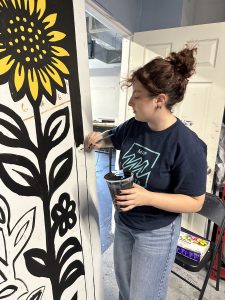
Painting a mural in preparation for a paint event at Barnes on the Block

At Mural Arts, every day is something different. I currently split my time between their main office and their Restorative Justice office. At the Restorative Justice office, I primarily work on project management with the department’s project manager. We work jointly on filling out information such as the artist selection process, to the project goals. I have also been working on categorizing artwork from those who are currently incarcerated at SCI Phoenix. Mural Arts has a partnership program that aids incarcerated artists through supporting their art as well as giving them employment at the prison. Just last week, there was a reception at the Barnes Foundation for the opening of the exhibit Where I’m From, which displays art by the men at SCI Phoenix as well as art from justice-impacted individuals part of Mural Arts’ Rec Crew. 

At the main office, I have been able to work with a variety of different departments. I have supported the Mural Arts Institute in hosting a workshop at Drexel University. I have also worked with Mural Operations in inputting information for site selection. However, I primarily work with the office manager to help support her in her daily tasks.   

Why did you apply for this internship?  

A mural dedication for Sanctuary Farm Philadelphia in Sharswood

After almost a year of living just outside Philadelphia, I was intrigued by the numerous mural art pieces I saw throughout the city. In doing some further research about prominent art organizations in Philadelphia, I found Mural Arts. By perusing their website, I found that a lot of their work was deeply rooted in social justice initiatives, and I was fascinated by the intersection between art and restorative justice. I wanted to learn more about how art can ignite social change and help justice-impacted individuals and those in reentry.  

What has been your favorite part of this internship? 

My favorite part of this internship has been all of the people I have been able to meet and all of the events that I have been able to attend. A year ago, I would have never imagined that I would get the opportunities that I have had at Mural Arts. Even individuals who work at Mural Arts have told me that they’ve also been able to have experiences that they never thought they would have before working at this organization. So far, I have been able to attend amazing events ranging from mural dedications to a private showing in the Barnes Foundation. 

Mural dedication at the Kensington Love Lot for an interchangeable mural. The Love Lot was created in partnership with Prevention Point Philadelphia with the goal of harm reduction

During my internship, I have been lucky enough to have the opportunity to speak with numerous talented artists, Mural Arts Executive Director and Founder Jane Golden, members of Congress, and many other notable individuals. Through long-time employees of the organization, I have also been able to learn so much about Mural Arts’ extensive history. I have heard first-hand accounts varying from Mural Arts’ origins as the Philadelphia Anti-Graffiti Network to when Mural Arts hosted Prince Charles and Camilla during their 2007 visit to Philadelphia. However, the most rewarding stories to hear have been those whose lives have changed for the better through their work with Mural Arts.  

What is most rewarding about your internship? 

What has been most rewarding about this internship is how many lives have been positively impacted by this organization. Many individuals who have been participants in Mural Arts’ social justice programs have been hired for long-term positions within the organization. For example, their program, called Color Me Back, has provided same-day work and pay for vulnerable communities, as well as giving them access to career and recovery services. Another example is from the Restorative Justice program, which has provided high post-program employment rates and recidivism rates that are much lower than the national average. 

Justice Up Close: My Summer Internship with the Federal Public Defender’s Office: Sanaiya Aftab ‘27 

Name: Sanaiya Aftab
Class Year: 2027
Major: Psychology, Literatures in English

Internship Organization: Federal Public Defender’s Office – District of Connecticut
Internship Title:  Mitigation Intern
Location: New Haven, CT

What’s happening at your internship? We would love to hear what kind of work you are doing!  

This summer, I am interning at the Federal Public Defender’s Office in New Haven, Connecticut, through the Liman Summer Fellowship at Yale Law School. My work sits at the intersection of legal research and narrative reconstruction. A large part of my work involves assisting in developing social histories: documents that attempt, often imperfectly, to account for the human context surrounding a criminal case. That context is rarely linear. It must be reconstructed from sealed records, institutional gaps, psychiatric assessments, and the granular debris of systems that record everything except what matters. The labor is cumulative. It demands a kind of attention that is as ethical as it is analytical. A large part of the work is trying to find words that hold weight without distortion; language that stays close to the violence without collapsing into performance. I am learning that truth does not always emerge through clarity, and that restraint, when used carefully, can protect more than it withholds. Sometimes, the most difficult part is knowing when to speak, and when to allow what is unsaid to remain intact. This is not the kind of work that seeks resolution. It asks how meaning is constructed, what narratives are admissible, and whose pain can be rendered legible within legal thresholds. The most difficult task is often the most essential: making a life intelligible without making it a spectacle. That challenge is not external to law; it is one of its central problems.  

Why did you apply for this internship?  

I applied for this internship because I was interested in how legal institutions reckon with harm: how they name it, narrate it, or, more often, render it invisible. I was drawn to the space of public defense not because it offers easy answers, but because it complicates the questions. What does accountability mean when histories of dispossession go unacknowledged? What possibilities exist for justice in a system that was not built to recognize certain lives as grievable in the first place? The Federal Public Defender’s Office stood out not only for its legal work, but for the structural role it plays in holding the system to its own standards. Public defense asks what it means to advocate when the odds are uneven by design, and how to tell a story that the law has already condemned as irrelevant. I wanted to be part of that process, not as a spectator but as someone learning to engage with the record as both evidence and omission. More than anything, I was looking for a space where legal research would not be abstracted from the people it concerns. This internship offered that. The work is technical, but it is also intimate. It requires listening as a form of method and writing as a form of responsibility. I applied because I wanted to understand what it means to do this kind of work well, and what is at stake when one fails to do so. 

Can you give us three adjectives and three nouns that describe your internship experience?  

If I had to choose three adjectives to describe this internship, they would be immersive, rigorous, and precise. The work does not permit detachment; it asks for full attention, both intellectual and emotional. It is rigorous in its demands. Every decision, omission, and sentence carries consequences. And it is precise, not only in terms of legal accuracy, but in the ethical discipline required to represent someone’s life without distortion.  

The nouns I would choose are narrative, record, and silence. Narrative, because so much of the work involves shaping meaning within constraints, building something coherent out of what is often fragmented or deliberately obscured. Record, because the archive is both a resource and a battleground. What appears there is incomplete, and what is missing can be just as telling. And silence, because it is everywhere: around trauma, inside institutional gaps, within families, and even between lines of text. Learning to read that silence without filling it has been just as important as anything I have written summer for me. 

Was this internship what you expected it to be? 

In some ways, yes. I expected this internship to be challenging, and it is. The legal system is dense, fragmented, and often resistant to the kinds of complexity that real lives carry. I anticipated long hours with documents, and I anticipated writing that would require precision. All of that has held true. What I did not expect was how much of the work would hinge on interpretation, not just of facts, but of gaps, silences, and omissions. I did not expect to spend so much time thinking about the ethics of tone, or how much weight a single adjective can carry in the context of someone’s life. I did not expect that so many questions would remain open, not because they lack answers, but because the answers themselves resist being flattened into evidence. This internship has not resolved my questions about the law. If anything, it has only sharpened them. But it has also given them contour. It has tethered them to forms of labor that are difficult, necessary, and often invisible. I came in thinking I would learn about the law’s failures. I am leaving with a deeper understanding of its structure, its blind spots, and the weight of trying to do good work within them. So no, this experience has not been exactly what I expected. It has been harder, quieter, and more morally dense. But I think that is exactly what makes it matter more to me.