Tiny and Mighty! Maya and Filomena ’26 Intern at Prison Radio

Name: Maya Mehta
Class Year: 2026
Major: Political Science 

Name: Filomena Baker
Class Year: 2026
Major: Political Science 

Internship Organization: Prison Radio
Internship Title:   Summer Interns
Location: Philadelphia, PA

What’s happening at your internship? We would love to hear what kind of work you are doing!  
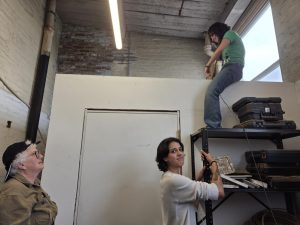
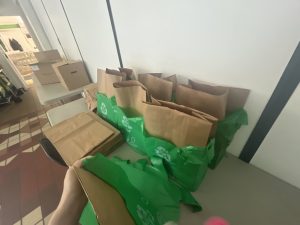
Doing repairs on our first week on the job!

As interns, Prison Radio delivers us something new and exciting every day. From producing a short-form movie to exploring political prisoner Mumia Abu-Jamal’s archives, we have learned the importance of Prison Radio’s abolition work. For the first few weeks of our internship, we immersed ourselves in Prison Radio’s vast catalogue of prisoner correspondent commentaries, sifting through thousands of Prison Radio’s audio files to transcribe and migrate them onto the website. We were then tasked with familiarizing ourselves with our Donor Network, writing hundreds of Thank You Cards to donors every day, whether they donated 5 dollars or 500. We quickly learned that our donor network, the people who believe in prison abolition, is the very backbone of the work we do, and that they are integral in keeping our national abolitionist community network strong. As we become more accustomed to how PR runs, we now spend our days writing eblasts for our network, organizing PR’s extensive archives, conducting research for different special projects, and, occasionally, we still write Thank You cards.

Why did you apply for this internship?  
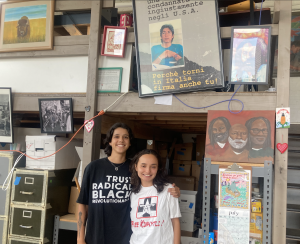
Us in the Prison Radio office

We wanted to intern at PR because we believe in the dismantlement of the hegemonic structure of the Amerikan empire. Prison Radio has been working against the prison-industrial complex for over 3 decades, broadcasting commentaries from incarcerated individuals and exposing human rights violations within the U.S. prison system. Additionally, the organization’s website has thousands of audio commentaries, art pieces, and resources relating to prison abolition, providing important content to the public that may have otherwise been unavailable. In the face of increased political repression and the expansion of carceral systems into our schools, hospitals, and places of work, the choice to intern with Prison Radio this summer was an easy one.

What has been your favorite part of this internship? 

After some initial hiccups in timing, we, along with other PR interns and our boss, met up at a small Indian restaurant in West Philly before embarking on a road trip. We were heading West to Pittsburgh. After driving 5 hours, we finally arrived at our first destination: the Monroeville Red Roof Inn Plus. We go to bed early that night, to wake for our next destination: the North Point Breeze Estate. The event: the fundraiser for the Abolitionist Law Center, an organization we work closely with.   

We arrive and are immediately put to work, tasked with helping create a charcuterie board, setting up seating, and greeting attendees at the door. All the writing of hundreds of Thank You cards came to fruition as we finally met the people who we had been addressing in our notes, and who have been keeping Prison Radio alive from afar. At the event, we met artists, lawyers, and long-time political and community organizers, hearing their stories and learning from them.   

Although it was hot and sunny, the event itself was one of the most memorable moments of our summer with Prison Radio. Being able to contextualize Prison Radio’s work within the larger context of abolitionism reminded us how early we are in our organizing journeys, and how the education we’ve had at Bryn Mawr is just the beginning. 

What is most rewarding about your internship? 

It’s the night of our movie premiere. It was the moment we’d been looking forward to for weeks. Just a month earlier, we had received an email from the Free Mumia Coalition in London looking for a 15 to 20-minute video of Mumia Abu-Jamal’s archives. Because of our boss’ close professional relationship with Mumia, Prison Radio has a large amount of Mumia’s mail, legal documents, and doctoral thesis work. We had a lot of work to do, and all the interns banded together to write a script, film B-roll, produce commentary, and interview people for the movie.   

After 3 weeks, we completed our movie and showed it to our boss. She immediately suggested hosting an official movie premiere in our office. Our work was far from over. We spent the next week calling and emailing people in the Philly area within our network.   

On the night of the premier, we had a full house, and we got to show our movie and meet the community members in Philly that had been a part of the Prison Radio network for years. It was incredibly rewarding to go through the process of researching, writing, and producing our film, and then getting to finally share it with others who cared for the work we have done just as much as we did. 
From Tools to Teamwork in Digital Scholarship: Grace Tsai ‘26


Name
: Grace Tsai
Class Year: 2026
Major: Economics
Minor: Data Science

Internship Organization: Library and Information Technology Services (LITS)
Internship Title:  Digital Technology Intern
Location: Bryn Mawr, PA 

What’s happening at your internship? We would love to hear what kind of work you are doing!  

I had the opportunity to work on three projects throughout my internship. 

The first project, completed in June, was the Institute for Liberal Arts and Digital Scholarship (ILiADS) Conference. The conference brought together teams of participants to build upon existing digital scholarship projects or even launch new projects entirely. It was an incredible experience that fostered collaboration, idea exchange, and innovation, and gave me the chance to see the process of developing digital scholarship projects firsthand. 

The second project focused on creating interactive data visualizations primarily with Tableau. I worked on designing clear and engaging visuals that will be featured on the Bryn Mawr College website. The goal of this project was to transform public data concerning the college into more visually appealing graphics for prospective students to reference in the future. 

The final project centered around lab safety. Alongside other interns, I created a series of videos to promote awareness of safe practices in laboratory environments. 

Why did you apply for this internship?  

My main goal for the summer was to build experience in data science, and the opportunity to build data visualizations interested me the most when applying. Investigating more, I was particularly intrigued in how digital scholarship was related to the data science field. I learned how digital scholarship could be a platform to improve public access to information, preserve cultural records, and tell stories with data. This internship has opened a door for how I think about the kind of work I want to pursue going forward.  

What has been your favorite part of this internship?  

My favorite part of this internship was the collaborative environment and the sense of purpose behind the three projects. From the start, I felt genuinely supported by the team. My supervisors encouraged me to ask questions and grow both personally and professionally. That support not only made it easier to connect with them, but also with my fellow interns and build a strong working dynamic.  

Can you talk about the skills you are learning and why they are important to you?  

I also gained valuable experience in project management. From the beginning, the team defined goals for each of the three projects and developed timelines to guide our work. I learned how to communicate effectively, adjust deadlines, and prioritize tasks to keep projects moving. The skills I learned through this internship are applicable in any professional setting, and I know I will continue to hone these skills as I take on future roles after graduation. 

Getting Up Close and Personal with Rat Brains: Lucy Sparks Mendez ‘26 

Name: Lucy Sparks Mendez
Class Year: 2026
Major: Neuroscience, Creative Writing

Internship Organization: Kennedy Krieger Institute
Internship Title:   Undergraduate Research Assistant
Location: Baltimore, MD

What’s happening at your internship? We would love to hear what kind of work you are doing! 

We are working on collecting and processing neurobiological and neurobehavioral data of rat pups and the response that early life stress has on their development.

Why did you apply for this internship?  

Before Bryn Mawr, I lived in South Philadelphia for three years. My condo was only a three-minute walk from the Old Pine Center. I fondly remember walking to and from school and my extracurricular activities, and passing Old Pine. Now that I am back in Philadelphia for college and have the opportunity to work, I wanted to reconnect with South Philly’s community and give back what they had given me: kindness, open-mindedness, and cultural experience. Why Old Pine and not another organization in South Philly? The Summer in the City program seemed to be the perfect fit. I have always enjoyed teaching children and learning from the new generation. Through them, I reconnect with the powerful tool of creativity and the skills of communication.

What was your favorite part of this internship? 

Having to be pulled from task to task in different areas of the center, I have met and befriended many people. In this process, many unique stories and conversations have arisen. This social aspect of Old Pine is my favorite part of my internship. Being a somewhat introverted and awkward person, talking to new people has been an impeding weakness; however, being in Old Pine’s friendly atmosphere, I have learned the importance of confidence and communication. Making small talk and opening myself up has proven to be interesting and helpful. After my internship, I hope to continue my newfound confidence and exploration of stories. 

Can you talk about the skills you learned and why they are important to you? 

A crucial skill my internship has highlighted is problem-solving. The children I work with are between the ages of three and twelve. Between these ages, social and mental skills are being developed. To ensure appropriate behavioral tendencies and respect, I need to be skilled in giving clear instructions, being compassionate, and open-minded to different needs. This problem-solving comes with positive and negative outcomes, but I learn what works and does not. This skill will be helpful in college when finalizing my major and other important steps towards my future. Not only does problem-solving help with my academic goals, but in my daily life. Many of us need to choose between many options daily. With limited time schedules, conflicting plans, and relationships, problem-solving is integral for decreasing stress and increasing happiness. In short, I am grateful for this internship and the skills that have come with it. 

Linh Nguyen ’28 Spends The Summer Gaining Valuable Hands-on Experience


Name: Linh Nguyen
Class Year: 2028
Major: Computer Science, Economics

Internship Organization: Library and Information Technology Services, Bryn Mawr College
Internship Title:  Digital Technology Intern
Location: Bryn Mawr, PA

What’s happening at your internship? We would love to hear what kind of work you are doing! 

Me, together with four other teammates, are working on three projects this summer. Our first project is to create visualizations for the data in the College’s Factbook. We have meetings with the Office of Institutional Research, Planning, and Assessment to make sure that we are on the right track with the visualizations and have included all the necessary information into our work. The second project is to help organize the ILiADS Conference in June by preparing designs for signage and nametags, and creating informative videos to help guide first-time visitors to our campus. Lastly, the third project is to create lab safety videos to help make the training more interactive, accessible, and efficient. For this project, we have meetings with the Office of Environmental Health and Safety to make sure we have covered all the necessary information in our videos.  

Why did you apply for this internship? 

As I approached the end of my first year in college, I knew I wanted to explore technological platforms and gain hands-on experience working in teams and engaging with clients. The Digital Technology Internship program with LITS aligns perfectly with these goals, offering me the opportunity to work on various projects while contributing to the Bryn Mawr community. Not only that, during the process, I will also have the chance to receive valuable mentorship from professionals. Through the experience, I hope to develop practical skills and form meaningful connections that will support my growth both personally and professionally.  

What has been your favorite part of this internship? 

My favorite part of this internship has been the ILiADS Conference week, where I had a fun and enriching learning experience. During this week, I was able to attend interesting and informative pop-up workshops about web hosting and Python – both topics I’m interested in. The two dinners I had with other participants gave me the opportunity to get to know new people from different colleges and improve my communication skills. 

What is most rewarding about your internship? 

The most rewarding part about my internship is the opportunity to learn new technological tools alongside my teammates and apply them directly to our projects. Throughout this internship, I have gained exposure to many new platforms, such as Tableau, Adobe Creative Cloud, and WeVideo. Learning how to use these tools on the go has helped me strengthen my adaptability and my ability to learn quickly. It has also been incredibly fulfilling learning and navigating through challenges with my peers and receiving help from each other whenever we run up against a technical issue. 

Another very meaningful aspect about this internship that I believe is significant to my professional growth is the direct conversations I had with the project clients to discuss our progress. It was my first time communicating with professionals in this context, and these client meetings required me to clearly explain my ideas while thoughtfully responding to their questions. This experience has really enhanced my communication skills, teaching me how to express ideas more clearly, listen actively, and tailor my explanations to different audiences. 

Hannah Carroll ’26 Interns at The Weitzman  


Name: Hannah Carroll
Class Year: 2026
Major: History of Art, History, German Studies 

Internship Organization: The Weitzman National Museum of American Jewish History
Internship Title:   Curatorial Intern
LocationPhiladelphia, PA
  
What’s happening at your internship? We would love to hear what kind of work you are doing!  

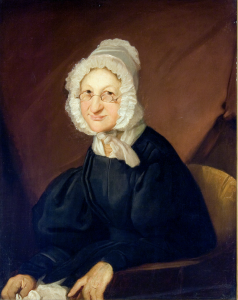
Who is she? Portrait of Mrs. N Eckstein by Louis Lang, 1839

Museums are surprisingly dynamic workplaces, meaning no two days are ever the same! I have done so many different things, from accessing objects, to getting really good at using an office scanner while digitizing old exhibition files. The Weitzman is hoping to unveil some new and improved exhibitions in the coming years, and many of the tasks I have worked on have been related to the museum’s upcoming temporary exhibition for the semiquincentennial (250th anniversary) of the Declaration of Independence called The First Salute. What I think is so amazing about this exhibition, which will follow the story of the Jewish community on Sint Eustatius in the Caribbean and its involvement with the American Revolution, is that it really highlights the sometimes unexpected dynamism and diversity (of peoples, of goods, of ideas, etc.) present in the 18th century Atlantic World. I cannot wait to see and share the final project with all of you next spring!

Why did you apply for this internship?  

Even before working there, the Weitzman was probably one of my favorite museums in Philadelphia. Believe it or not, it is the only Jewish museum in the country which focuses exclusively on telling the stories of the American Jewish experience from the 17th to the 21st century. Working in a museum was something I have really wanted to do since I started college, and the Weitzman unique collection and specialties would help me bridge connections between many of my academic passions, such as American history and Jewish history, as well as object interpretation and material culture. I also feel that working in a Jewish museum and helping to tell these stories of American Jewish life is particularly needed in our current moment in which anti-Jewish bigotry has become commonplace in our politics and culture.  

Was there anything special about how you found this internship? 

Yes! I had really been struggling in my search for an internship, and I was talking to one of my friends who was working at the Weitzman as part of the Praxis program this spring and really loved the work she was doing. Even though I am probably not going to be able to do a Praxis next year, I reached out to the Praxis director, Tiffany Stahl, who said that she heard the museum was actively searching for summer interns and gave me the email of my eventual supervisor. I know this is incredibly schmaltzy, but if you are struggling in your search for internships, it never hurts to ask for information from friends, your advisors, or even the Career and Civic Engagement Center — it is their job, after all!

What was your favorite part of this internship? 

“Everything” is kind of a silly answer, but I mean it! I have loved both the breadth and depth of my work there.
  
Can you talk about the skills you are learning and why they are important to you?

Learning how museums work has been very fulfilling as an art history major, because it has shown me what kinds of things I can do with my degree as I pursue further study. Understanding a museum from the inside out has also helped me think about how to research better, especially as I prepare to write my thesis. I have been working on solving the mystery of one particular painting in the museum’s collection, a portrait of a woman from the late 1830s. We know basically nothing about her except for her last name and the artist who painted her portrait. Uncovering her story has led me down so many different paths, as I research the life of a woman who, pending further evidence, I suspect may be the sitter. It has also been interesting (and sometimes a little frustrating) to read the internal records we have on the painting, and see how others who have attempted to identify her have tried and failed, and at times made and propagated shaky claims about who she was, somewhat like a game of art-historical telephone! Hopefully if I am similarly unable to confirm her identity, I can at least leave a better framework and documentary trail for the next person in my stead. The lives of American Jewish women before the late nineteenth century are quite under-researched (although this is slowly changing), and I hope that in the future my own research will build upon illuminating more stories like this! 

Navigating Summer for Youth in Philly with Aylee Fromal ‘28

Name: Aylee Fromal
Class Year: 2028
Major: Intended Political Science 

Internship Organization: Old Pine Community Center
Internship Title:  Summer of Service Intern
Location: Philadelphia, PA

What’s happening at your internship? We would love to hear what kind of work you are doing! 

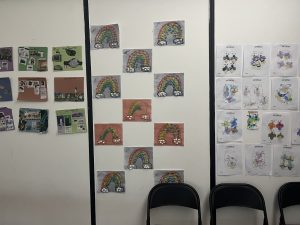
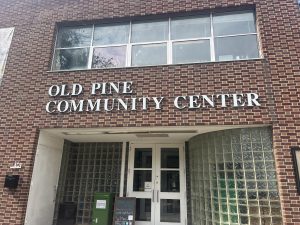
I am a summer camp intern and food distributor at the Old Pine Community Center in South Philadelphia. Old Pine provides many services to the South Philly community and youth. From renting out spaces for community events to partnering with local businesses to fight food insecurity. This summer, as an intern for Old Pine’s Summer in the City program, I have brainstormed and implemented daily activities, recorded and aided in the production of weekly plays, and cleaned the center before and after the camp. A day-in-the-life of an Old Pine intern has been challenging but also rewarding. It is not only those tasks listed above that I execute, but also being readily available to other staff. Old Pine is in the process of finding more staff, so I might be asked to help with packing boxes, watching the front, or prepping grocery bags.
Why did you apply for this internship? 

Before Bryn Mawr, I lived in South Philadelphia for three years. My condo was only a three-minute walk from the Old Pine Center. I fondly remember walking to and from school and my extracurricular activities, and passing Old Pine. Now that I am back in Philadelphia for college and have the opportunity to work, I wanted to reconnect with South Philly’s community and give back what they had given me: kindness, open-mindedness, and cultural experience. Why Old Pine and not another organization in South Philly? The Summer in the City program seemed to be the perfect fit. I have always enjoyed teaching children and learning from the new generation. Through them, I reconnect with the powerful tool of creativity and the skills of communication.
What has been your favorite part of this internship? 

Having to be pulled from task to task in different areas of the center, I have met and befriended many people. In this process, many unique stories and conversations have arisen. This social aspect of Old Pine is my favorite part of my internship. Being a somewhat introverted and awkward person, talking to new people has been an impeding weakness; however, being in Old Pine’s friendly atmosphere, I have learned the importance of confidence and communication. Making small talk and opening myself up has proven to be interesting and helpful. After my internship, I hope to continue my newfound confidence and exploration of stories.
Can you talk about the skills you learned and why they are important to you?

A crucial skill my internship has highlighted is problem-solving. The children I work with are between the ages of three and twelve. Between these ages, social and mental skills are being developed. To ensure appropriate behavioral tendencies and respect, I need to be skilled in giving clear instructions, being compassionate, and open-minded to different needs. This problem-solving comes with positive and negative outcomes, but I learn what works and does not. This skill will be helpful in college when finalizing my major and other important steps towards my future. Not only does problem-solving help with my academic goals, but in my daily life. Many of us need to choose between many options daily. With limited time schedules, conflicting plans, and relationships, problem-solving is integral for decreasing stress and increasing happiness. In short, I am grateful for this internship and the skills that have come with it. 

Teaching English with Lucia Swaner ‘27 


Name: Lucia Swaner
Class Year: 2027
Major: French 

Internship Organization: St. James Immigrant Assistance
Internship Title:   St. James Immigrant Assistance and Outreach Intern
Location: Seattle, WA

What’s happening at your internship? We would love to hear what kind of work you are doing! 

The bulk of this internship is one-on-one ESL tutoring. As I’m committing a large chunk of my summer to this organization and I’m not a volunteer tutor like most other ESL tutors for St. James Immigrant Assistance, I have more students. These students have a wide variety of backgrounds, needs and desires for their English-learning experiences. Some of SJIA’s clients have young kids and so have to have their tutoring online. Others have young kids and so don’t get a moment to themselves, so we do our best to let the kids be involved in English lessons. I travel all over the greater Seattle area most days of the work week to meet students where they are.

Why did you apply for this internship? 

I applied for this internship first and foremost because it takes place at my parish in Seattle. St. James is a community I grew up in and I admire their large number of non-profit ministries. I had participated in some of those programs before but I had never volunteered with Immigrant Assistance. Immigrant Assistance turned out to be such a good fit for me because it applies nearly directly to my intended career path as a language teacher.

Was there anything special about how you found this internship? 

Something I didn’t expect to learn from this internship was teaching in a group setting. I started out with just a couple confirmed students on Day 1 who were all supposed to be one-on-one sessions. As the weeks progressed, I gained not only a few lessons a week with two to four people, but a whole nine-person class at a senior living facility serving Russian speakers. I quickly discovered the benefits of teaching a language in a larger group. People learning together can see and hear that they are supported by the rest of their class. They are more confident in making mistakes and trying new words than just one student would be. Allowing yourself to make mistakes is the most important step when it comes to building the courage to learn a new language. 

Can you talk about the skills you learned and why they are important to you? 

Another one of the skills I won’t forget is the people skills I am able to develop with the St. James Mental Health and Wellness Ministry. Week by week, we invite people in to participate in activities to support their mental health. Not only have I picked up mental health coping skills, but I have learned how to foster those in other people. Though that might not be in the job description for most teaching positions, perhaps it should be. It takes a compassionate person who can both talk to and listen to students to be a teacher who’s remembered for the right reasons.  

Teaching for Change Abroad: My Experience Interning with a Social Justice and Creative Learning Center  


Name
: Madison Carter
Class Year: 2025
Major: Psychology
Minor: Africana Studies

Internship Organization: Die Gelbe Villa
Internship Title:   Creative Learning and Workshop Facilitation Intern
Location: Berlin, Germany

What’s happening at your internship? We would love to hear what kind of work you are doing!  

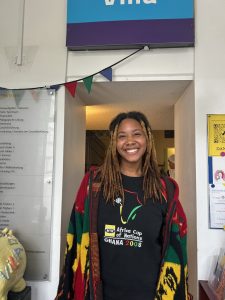
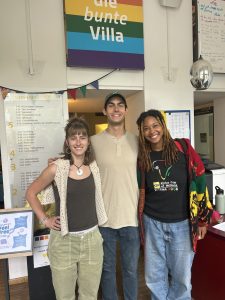
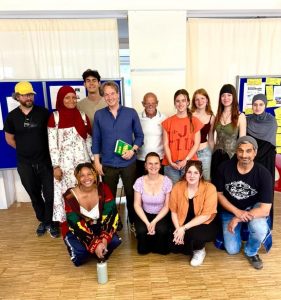
I worked with children ages six to sixteen assisting them with building social, political, and creative skills. Each week I worked alongside 3-7 workshop leaders, five voluntary social year workers, and two other IES interns to guide students through topics of democratic, climate, and social justice issues. These children came from varied school environments and were separated into small groups for workshops. I assisted in fashion and sustainability workshops, short filmmaking, wood workshops, AI image generation and photography comic strip workshops, and a happiness workshop. I was also trusted with planning potential project excursions for students to gain exposure beyond the villa.
Why did you apply for this internship? 

I applied for this internship because it stood out to me among the other options offered to me. This workshop not only allowed me to gain experience with children but mainly children of different cultural backgrounds that come from predominantly low-income families. I want to uplift and support adolescents of these demographics now and in my future career. The villa prioritizes not only education and open learning discussions but also creative expression in various forms. Two topics that I both value and have interest in.

Was there anything special about how you found this internship? 

I immediately connected with my supervisors while interviewing with them and formed a quick bond that foreshadowed the relationship we were meant to have while working with this organization.
What has been your favorite part of this internship?

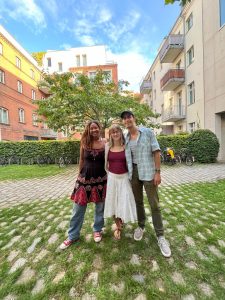
Meeting and making connections with the brilliant children that come to the villa. Additionally, the relationships I cultivated with the faculty/staff and interns that work with the villa. They made my experience in Berlin and with this organization one that I will never forget and will maintain through the next chapter of my life post-graduation.  

What is something you have learned from your internship that you didn’t expect? 

I learned that I am very resilient and able to navigate and thrive in different working environments even when they are speaking a language that I cannot understand. 
What has been the biggest challenge you have faced at your internship? 

The biggest challenge was the language barrier. I do not know any German and was told that most of my internship would be English speaking, however this was not the case. I was able to adapt using different forms of communication with an emphasis on nonverbal communication and being attentive towards body language.  

Can you talk about the skills you learned and why they are important to you? 

I continued to grow leadership skills in a constantly changing environment, embracing flexibility with schedule developments, advocacy skills, and continuing to work in childcare and make connections. These skills are important to me because they show that I am adaptable and prioritize growth and service. They help shape who I am becoming and emphasize that I show cross-cultural adaptability. 

What is most rewarding about your internship?  

Meeting the kids and working with them.

Was this internship what you expected it to be? 

It was not what I was expecting at all but turned out to be even better than I could have hoped. 

Can you give us three adjectives and three nouns that describe your internship experience?

Dynamic, resilient, creative  

connection, community, perspective 

Emily Chau ’26 Explores Autism Research at CHOP 


Name: Emily Chau
Class Year: 2026
Major: Psychology

Internship Organization: Children’s Hospital of Philadelphia, Center for Autism Research
Internship Title:   Student Research Trainee
Location: Philadelphia, PA

What’s happening at your internship? We would love to hear what kind of work you are doing! 

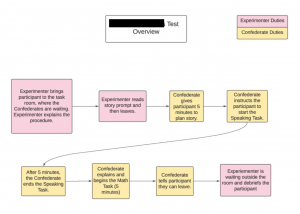
Experimenter and confederate protocol for a study I am currently doing

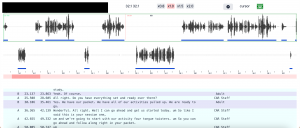
This summer, I am working as a student research trainee in the Social Attention and Language Lab at the Children’s Hospital of Philadelphia’s (CHOP) Center for Autism Research (CAR). I actually started this internship in the Spring 2025 semester as part of Bryn Mawr’s Praxis Independent Study program, but a lot of my responsibilities in the lab have changed. In the spring, I mostly transcribed casual conversations between speakers and autistic or non-autistic youth to investigate markers of autistic speech. I am still doing this, but I am also starting to become more involved in the front-end part of the lab’s research. For one study, I am currently training to be a confederate to have conversations with autistic or non-autistic youth. Instead of transcribing researcher-participant conversations, I will now be part of those conversations. In that same study, I am also training to be a confederate where I will instruct autistic participants to do difficult tasks as part of the study procedure. I am really looking forward to interacting with participants since most of my spring experience was transcription and shadowing studies.  

Example of two audio files and their transcriptions

I have also been added to multiple other studies that span across a variety of other speech and autism-related topics. For example, I am reviewing and editing transcripts that focus on the experiences of mothers who were pregnant/gave birth during the COVID pandemic. Later in the summer, I may start reaching out to families of autistic children to ask if they will participate in a study related to an AI reading tool. In between all of these studies and tasks, I attend talks and similar events at CHOP that explore different topics and career paths in autism research. For example, we have a speaker series where lab alumni talk about their career after leaving the lab. In the next couple of weeks, I will be attending the Linguistic Data Consortium at UPenn, and I may be able to shadow a diagnostic visit at the main hospital. In all, I’m getting exposed to many different kinds of research tasks, clinical tasks, and topics here at CAR.

Why did you apply for this internship?  

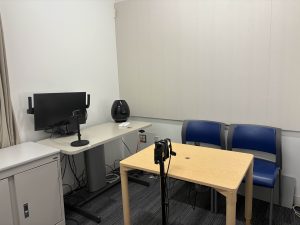
An exam room that’s set up for a study task

I applied for this internship because the mission of CAR spoke to me personally, and I felt that my unique experiences would be a valuable asset to autism research. I have a brother with autism, and we went to CHOP as kids. Because of this, I have seen firsthand the outcomes of CAR’s research through the comprehensive care and supportive groundwork that CHOP has provided to my family and other members of my community who have autism. I wanted to give back to this organization while also serving the autism community using the analytical skills I have gained as a psychology major at Bryn Mawr. I hoped to exercise my research skills while doing meaningful work in a topic I’m personally passionate about.  

I also applied because I am pursuing a degree in social work, and I intend to keep serving this population. Even though this position isn’t entirely clinical or client-facing, I hope to gain a more holistic understanding of the experiences of this population as well as what kinds of research inform social work practices. 

What has been the biggest challenge you have faced at your internship? 

I think the biggest challenge I have faced is the one I am facing right now: the independent research project and presentation. As part of the summer program, student research trainees can choose to do an independent research project and do a short presentation about it in front of all the different labs and principal investigators at CAR. Even though I grew up with an autistic sibling, I find that there are still many aspects surrounding autism that I have yet to learn about, especially when talking to other members in the lab about their diverse research interests. It has been challenging to come up with and to research a novel idea for this project knowing that the people at CAR are experts in this field, but I have been proactive in reaching out to lab members who have similar research interests for guidance. Everyone on my team and at CAR has been very friendly and open to being asked questions, so I feel well-supported in my independent research project.  

Was this internship what you expected it to be?  

Because I started this internship in the spring, I thought that the summer would be more of the same. However, this internship surprised me because of how active and busy it is in the summer. The summer program for this internship is also a lot more structured than it was in the spring because there is a set schedule for events such as alumni talks, conferences, the Linguistic Data Consortium, study visits at the research center and at the main hospital, and the student research presentation day.  

Since the summer has started, I’ve been able to meet more lab members within and outside of my team. I was surprised by how approachable and considerate lab members were because I thought there would be a stark divide between lab members and student trainees. I feel that I can reach out to people within and outside of my team about autism research as well to discuss my academic journey outside of CAR. 

Delaney Cairns ’26 Interns with AMADEUS Festival Vienna


Name: Delaney Cairns
Class Year: 2026
Major: Psychology, Education

Internship Organization: AMADEUS International School Vienna, IES Abroad 

Internship Title:  AMADEUS Music and Arts Academy Intern
Location: Vienna, Austria

What’s happening at your internship? We would love to hear what kind of work you are doing! 

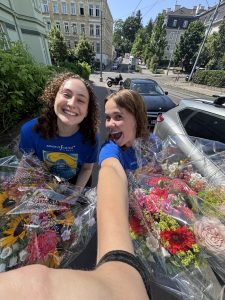
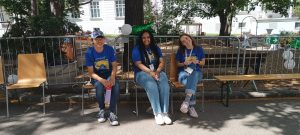
The Amadeus International School Vienna is a Private PreK-12 school focused on IB curriculum with an integrated Music and Arts Academy (AMAA). I was working in the front office, most specifically with the AMAA administrators, dealing with and helping with the scheduling and planning required to run the academy. I was even able to sit in on some dance and music classes, and it was super interesting to learn about the dance and music education scene in Vienna. Additionally, I was involved in the planning of the Amadeus Festival hosted by the school at the end of each year. During the festival, the other interns and I helped serve the guests and assist with the other logistical needs of the festival as part of the stage crew. We were also tasked with making a performance to open up one of the acts in the festival and we choreographed a dance together! I also was able to incorporate some of my dance interests when I led an Irish dance workshop on the “Family and Fun Day” of the festival. Finally, I moderated one day of the festival, going on stage to introduce the different groups and talk a little bit about their performances. 
Why did you apply for this internship? 

As an education major, I was really interested to see what goes on behind the scenes at a school. Through the Bryn Mawr education department I have had the opportunity to see the inside of many classrooms in Philadelphia schools, but I have never been able to see the behind the scenes of a front office in the way that I was able to at Amadeus. I really enjoyed learning how to look at registration lists, plan out classroom space schedules, and help make certificates. I also have been focusing a lot on arts (most specifically dance) education and the impact it has on students in my studies at Bryn Mawr, and wanted to see how it was being incorporated into this school. I was also interested in seeing how a school/workplace functions in a different country such as Austria in order to explore how it differed from my experience in US schools. 
Was there anything special about how you found this internship? 

I was a part of a group of Bryn Mawr students who got the opportunity to be a part of the IES Vienna Internship program for the summer. This gave me the opportunity to meet so many other people from different schools across the country and hear all about the work they were doing at their internships and how it related to their studies. 

What has been your favorite part of this internship? 

My favorite part of my experience at this internship was being able to get so close with the other interns at Amadeus. I really learned how to work well with a team and we all learned how to advocate for ourselves and each other. It was so nice to have a group that supported each other with any help we needed every day. We also all learned how to communicate effectively with one another and our supervisors in a workplace environment (in another country!).