Name: Hannah Carroll
Class Year: 2026
Major: History of Art, History, German Studies
Internship Organization: The Weitzman National Museum of American Jewish History
Internship Title: Curatorial Intern
Location: Philadelphia, PA
What’s happening at your internship? We would love to hear what kind of work you are doing!
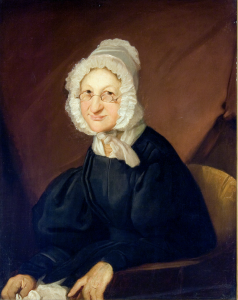
Who is she? Portrait of Mrs. N Eckstein by Louis Lang, 1839
Museums are surprisingly dynamic workplaces, meaning no two days are ever the same! I have done so many different things, from accessing objects, to getting really good at using an office scanner while digitizing old exhibition files. The Weitzman is hoping to unveil some new and improved exhibitions in the coming years, and many of the tasks I have worked on have been related to the museum’s upcoming temporary exhibition for the semiquincentennial (250th anniversary) of the Declaration of Independence called The First Salute. What I think is so amazing about this exhibition, which will follow the story of the Jewish community on Sint Eustatius in the Caribbean and its involvement with the American Revolution, is that it really highlights the sometimes unexpected dynamism and diversity (of peoples, of goods, of ideas, etc.) present in the 18th century Atlantic World. I cannot wait to see and share the final project with all of you next spring!
Why did you apply for this internship?
Even before working there, the Weitzman was probably one of my favorite museums in Philadelphia. Believe it or not, it is the only Jewish museum in the country which focuses exclusively on telling the stories of the American Jewish experience from the 17th to the 21st century. Working in a museum was something I have really wanted to do since I started college, and the Weitzman unique collection and specialties would help me bridge connections between many of my academic passions, such as American history and Jewish history, as well as object interpretation and material culture. I also feel that working in a Jewish museum and helping to tell these stories of American Jewish life is particularly needed in our current moment in which anti-Jewish bigotry has become commonplace in our politics and culture.
Was there anything special about how you found this internship?
Yes! I had really been struggling in my search for an internship, and I was talking to one of my friends who was working at the Weitzman as part of the Praxis program this spring and really loved the work she was doing. Even though I am probably not going to be able to do a Praxis next year, I reached out to the Praxis director, Tiffany Stahl, who said that she heard the museum was actively searching for summer interns and gave me the email of my eventual supervisor. I know this is incredibly schmaltzy, but if you are struggling in your search for internships, it never hurts to ask for information from friends, your advisors, or even the Career and Civic Engagement Center — it is their job, after all!
What was your favorite part of this internship?
“Everything” is kind of a silly answer, but I mean it! I have loved both the breadth and depth of my work there.
Can you talk about the skills you are learning and why they are important to you?
Learning how museums work has been very fulfilling as an art history major, because it has shown me what kinds of things I can do with my degree as I pursue further study. Understanding a museum from the inside out has also helped me think about how to research better, especially as I prepare to write my thesis. I have been working on solving the mystery of one particular painting in the museum’s collection, a portrait of a woman from the late 1830s. We know basically nothing about her except for her last name and the artist who painted her portrait. Uncovering her story has led me down so many different paths, as I research the life of a woman who, pending further evidence, I suspect may be the sitter. It has also been interesting (and sometimes a little frustrating) to read the internal records we have on the painting, and see how others who have attempted to identify her have tried and failed, and at times made and propagated shaky claims about who she was, somewhat like a game of art-historical telephone! Hopefully if I am similarly unable to confirm her identity, I can at least leave a better framework and documentary trail for the next person in my stead. The lives of American Jewish women before the late nineteenth century are quite under-researched (although this is slowly changing), and I hope that in the future my own research will build upon illuminating more stories like this!