Name: Sarah Kurth
Class Year: 2028
Major: Intended History of Art, Spanish
Internship Organization: Bryn Mawr Department of Spanish
Internship Title: Digital Humanities Fellow
Location: Virtual/Salt Lake City, UT
What’s happening at your internship? We would love to hear what kind of work you are doing!
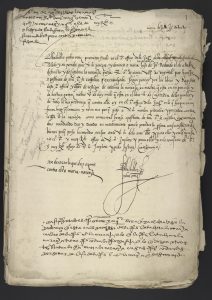
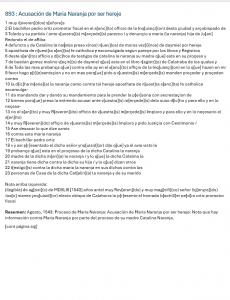
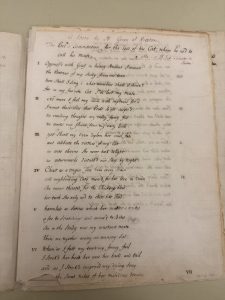
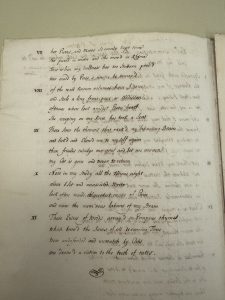
I’ve been transcribing Spanish Inquisition trial documents housed at the University of Pennsylvania. I completed transcriptions of five trials, each centered around a woman accused of being a false convert from Islam to Catholicism. I read through the folios in their entirety, created a plain-text copy in a working document, and included short summaries of the content at the bottom of each page. To finalize my internship, I authored a blog published at UPenn. I’ve really enjoyed getting a look at what daily life looked like for the five women before and after their imprisonments by the Inquisition.
Folio 893 from the Henry Charles Lea Collection Ms. 728
Why did you apply for this internship?
I’d been doing Paleography work during the Spring Semester with Professor Phipps, and had fallen in love with the process of transcription as well as the content within these primary documents. I thought that this internship would be an amazing opportunity to explore what a focus of career in a similar field could look like. I’m so excited to continue my work this year and in the future, potentially through a senior thesis.
Was there anything special about how you found this internship?
I found it through being the facilitator for Professor Phipps’ Paleography Working Group, a weekly meeting of interested students that I’m excited to continue working on this coming year.
What has been your favorite part of this internship?
my transcription
I was consistently moved by the stories included in the trial’s witness testimonies. There were so many beautiful moments of female relationships across the five trials. It’s staggering to witness events that occurred 500 years ago, that could have just as easily happened last week, like two sisters being sent to sleep over at their friends house while their parents were out of town.
Can you give us three adjectives and three nouns that describe your internship experience?
Tragic, beautiful, nuanced. Spain, religion, justice.
Can you talk about the skills you are learning and why they are important to you?
Paleography is such a specific skill, and I’ve loved getting to familiarize myself with specific notary’s scripts, as well as the general vocabulary and formatting of Inquisition trials. Even if I don’t go into a paleography-related field as a career, I think that the critical thinking skills and added Spanish vocabulary will aid me in the future.
What is most rewarding about your internship?
Getting to familiarize myself with women whose lives were not evaluated positively. It’s my hope that my work this summer will make the trails more accessible to future engagement and research, broadening the impact of these women’s trials on Inquisition scholarship.
Was this internship what you expected it to be?
Everything and more!

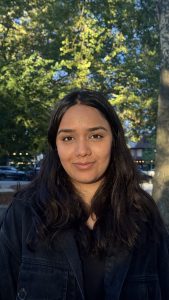

 This summer I have been interning for Dr. Elizabeth Corredor, Professor of Political Science at Bryn Mawr. In the beginning of June we went to Mexico City for a Women’s Peace and Security conference where I acted as the note taker and translator for Professor Corredor. I then have been tasked with writing the policy report that will later be sent to the Canadian military to help promote an anti femicide agenda. Traveling with Professor Corredor and spending time in Mexico City allowed me to immerse myself within the culture and work on my Spanish while I was there. Meeting such incredible women who are passionate about the extreme amounts of femicide in Mexico was so inspiring. I am able to take my newfound research and policy report skills back to Bryn Mawr with a new global view.
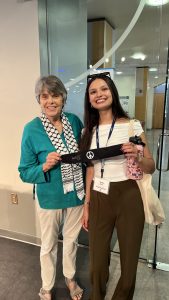
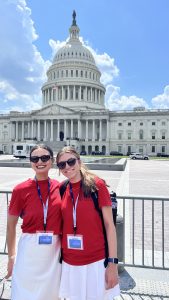 This summer, I had the opportunity to work mentoring a cohort of high school students at the annual Free Speech forum, where I was able to provide program support by facilitating discussions and homerooms on free speech, constitutional, and First Amendment rights. The Free Speech forum is a week-long program organized by the Foundation for Individual Rights and Expression (FIRE) where high school students engage with free speech rights, hear from speakers like Mary Beth Tinker on their rights, and engage with Capitol Hill through field trips and other daily activities. I was also in charge of preparing detailed incident reports for FIRE staff, documenting participant experiences, and promoting a safe, inclusive environment for students by modeling good behavior and addressing participants’ needs. I was also able to gain more knowledge about constitutional law, network and work alongside other college student counselors from universities across the country, such as the University of Pennsylvania, Harvard, Georgetown, Columbia, UChicago, and Penn State, who were also passionate about the free speech of students on our college campuses.