Name: Charlize Hoeun
Class Year: 2027
Major: Geology
Internship Organization: Department of Geology, Bryn Mawr College
Internship Title: Student Researcher
Location: Bryn Mawr, PA
What’s happening at your internship? We would love to hear what kind of work you are doing!
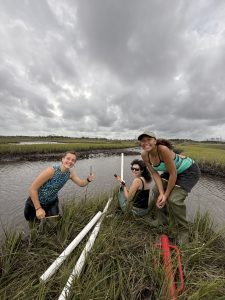
Two lab mates and I installing a water conductivity meter in a NC marsh
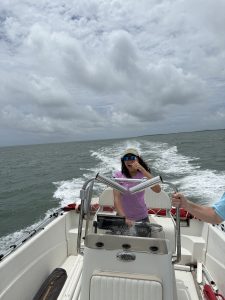
This summer I was able to work in a Sedimentology lab under my recent professor, Don Barber. Our main focus was to answer the question of whether or not the salinity levels of soil have any effect on carbon sequestration in salt marshes along the East Coast. While I’ve spent the majority of the summer inside of the lab here at Bryn Mawr, I’ve traveled to New Jersey and spent a couple of weeks in North Carolina with my professor and lab group. In New Jersey, we learned how to collect core samples from the ground and properly preserve them in order to be analyzed later on. In North Carolina, we collected more core samples from coastal wetlands but also installed multiple water level monitors that would constantly feed live data about the water conductivity back to us. Salt marshes are large recipients of atmospheric carbon due to the abundance of organic matter contained within marshes that accumulates and traps CO2. We made this data available to the public via a short infographic that could be accessed through a QR code. The QR codes are pasted onto the water monitors in the small coastal town we studied in North Carolina, whose population consists of a tight-knit community that has generally been uninformed of the seriousness of sea-level rise and how directly they will be affected in the near future. Inside of the lab, we analyze our core data through a series of procedures that tell us things like the mass of the organic matter and carbon concentration per centimeter. The mix of both scientific and social work has allowed me to adopt an array of new skills in the enriching environments I never would have been exposed to had I not been given this opportunity.
Why did you apply for this internship?
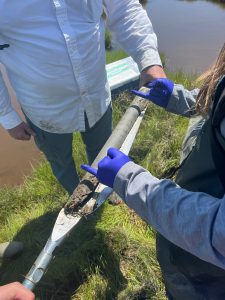
Visual analysis of a core sample out in the field
I have worked with environmental organizations before, and I loved the learning experience it provided me with. I think it’s extremely important to begin sharing information and developing solutions for the inevitable effects of climate change; it’s much too late to reverse it, so keeping people safe and informed is the next best priority. Much like my professor, Don Barber, my hometown and surrounding areas are at high risk of being impacted by the heating of our oceans. His passion for research and getting through to residents in coastal cities reminded me of my own interests, and I was elated to be offered a position to work under him this summer.
What has been your favorite part of this internship?
My favorite part of this internship has definitely been the fieldwork. Although it’s proven extremely challenging to dig meters down into the ground on hot days in full coverage clothes and high rubber boots, the fun of it outweighs the struggle. When we would hit sand and clay material during the coring processes, we would use the full body weight of everyone in the field to penetrate through the sticky, dense layers. The contrast between the strenuous labor we did outside together and the tedious analyses that took place in the laboratory made for a very engaging workload; it was never boring because we were always tasked with something different and cool. I also happen to enjoy road trips, and my lab has had our fair share of them this summer to get to the sites we’d mapped in multiple states.
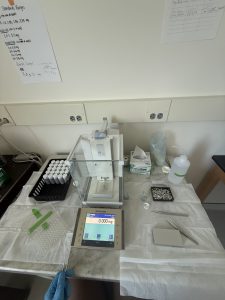
Lab balance for weighing milligrams of samples to be analyzed for their carbon
Can you give us three adjectives and three nouns that describe your internship experience?
The adjectives I would give this internship are exciting, thought-provoking, and relevant. Some nouns I’d use to describe it would be nature, team and mud.