
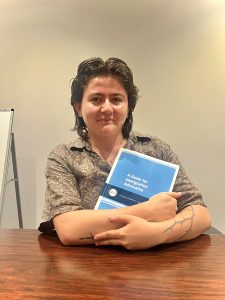
Name: Cass Fischer Murphy
Class Year: 2026
Major: Spanish
Minor: Gender and Sexuality Studies, Philosophy
Internship Organization: Esperanza Immigration Legal Services
Internship Title: Legal Intern
Location: Philadelphia, PA
What’s happening at your internship? We would love to hear what kind of work you are doing!
I work at Esperanza Immigration Legal Services, the small legal department of the nonprofit Esperanza, which serves low-income immigrant communities in Philadelphia. Due to its limited capacity for representation (there is only one attorney), its legal services primarily comprise work outside of the courtroom. A large amount of this work involves assisting people with their citizenship applications. Though a relatively lower-risk immigration status to be in, the process is still difficult for our clients for a variety of reasons, be they related to finances, language, age, or literacy. Completing the application for naturalization can involve assisting clients with their taxes, medical records, among other bureaucratic things. Naturalization clients are very rewarding to work with, as citizenship represents a big step for them and is easy to achieve with the right advocacy. Two of my most happy moments at work have been interpreting for a woman who passed her citizenship interview, and co-teaching a citizenship interview test prep class. The second-most common kind of petition I have dealt with is asylum– a much riskier and harder to access legal protection. Eligibility for asylum is multi-tiered and fairly specific, and highly influenced by contemporary politics. Constructing a claim involves a balance of personal testimony, country conditions, and legal analysis. Filing pro se asylum applications has illuminated to me the vast failures of the US immigration system. For example, the fact that the executive branch was legally able to cancel Temporary Protected Status for 350,000 Venezuelan asylum seekers in the US without advance notice highlights the chaotic and unstable nature of the system as a whole. It is very disheartening to not be able to give an answer to asylum seekers when they ask about their futures– nothing is certain anymore. Yet, helping someone file their application makes a huge difference for them, even if their chances of it being granted are slim. It isn’t up to me to decide what work is “worth it” or not– though the system makes it harder and harder to help people, it means that the need for immigration advocacy is even more urgent.
Why did you apply for this internship?
I’m interested in pursuing immigration law as a potential career, and for that reason I decided to intern at an immigration nonprofit. I want to work in immigration law because it’s one of the most pressing issues of our time, and because it allows me to draw on my studies in Latin American history.
What is something you have learned from your internship that you didn’t expect?
My experiences with immigration law have shown me the real-life effects of the historical events I have studied here at Bryn Mawr. Through my studies in Latin American history, I understand that a lot of the turmoil plaguing Latin America today is a direct consequence of U.S. interventions and extractivist policy dating from the 20th century to today. The U.S. has made itself rich from Latin America, and then it exploits and dehumanizes the people that it has displaced. That’s what makes recent events all the more galling. Yet, I’m glad that I am able to use my studies in a way that directly helps people.
Can you talk about the skills you learned and why they are important to you?
For anyone interested in helping asylum seekers, many nonprofits will have regular clinics where you can help people apply for asylum, both remote and in person. Philly has a lot of great organizations– I would recommend looking at the member groups of the Pennsylvania Immigration Coalition to start!