Name: Laurel Gabbard
Class Year: 2026
Majors: History of Art, Spanish
Minor: Museum Studies
Internship Organization: Archivos de la Facultad de Artes en la Pontificia Universidad Católica de Chile
Internship Title: Archives Intern
Location: Santiago, Chile
What’s happening at your internship? We would love to hear what kind of work you are doing!
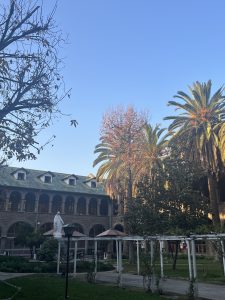
Pontificia Universidad Católica de Chile
This summer, I have been interning in Santiago, Chile, working in the archives of the School of Arts at the Pontificia Universidad Católica de Chile. As an intern working in the theater archives, I have been introduced to a wide array of archival materials, including but not limited to documentary footage, interviews, photos, letters, posters, and theater programs. My main task consisted of transcribing, subtitling, and translating three documentaries that focus on different elements of Chilean theatrical history, all of which, in some capacity, focused on theater as a revolutionary act that can operate as a push against state power and dictatorship. I also transcribed interviews conducted with Alberto Kurapel and Susana Cáceres, Chileans living in exile in Canada during the dictatorship, and who, in their time in Montreal, formed a theater company that produced acts based on their own experiences in political exile. I also had the chance to meet with the subject of one of the documentaries, Jacqueline Roumeau, the founder of an organization that coordinates theater, and more broadly, art opportunities, within prisons as an act of rehabilitation and reintroduction into society after incarceration. My supervisor recently presented the three documentaries that I subtitled at a three-day long event at the Chilean embassy in Buenos Aires, Argentina, and knowing that I contributed to the accessibility and understanding of these visual archives is very exciting!
Why did you apply for this internship?
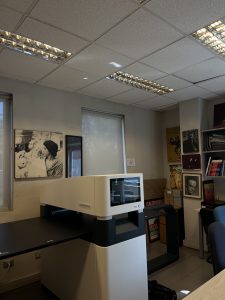
Digital Humanities Lab
I originally applied for the IES Abroad summer internship program, along with Career and Civic Engagement funding knowing that I wanted the opportunity to live and work in a Spanish-speaking country and get more comfortable with my professional abilities in my second language. As I worked with IES to find an internship placement, I knew I wanted to be in the arts and humanities sector, so when I was presented with the opportunity to interview for a position in the archives of the School of Arts, I knew that would receive the guidance and experience I was looking for!
What has been your favorite part of this internship?
My favorite part of this internship, besides the professional experience I have gained, has been getting to know my coworkers and supervisors, and in doing so, gain insight not only into professional life in Chile, but also being able to learn tons about Chilean culture, history, social issues, and be a part of the day to day office conversations! My coworkers, in addition to other university-age interns at the office all welcomed me with open arms and helped me learn tons about what it is like to be young in Chile, and I feel very lucky to have had this experience of full linguistic and social immersion in addition to my professional experience.
What is something you have learned from your internship that you didn’t expect?
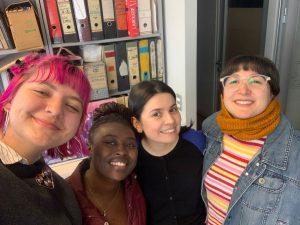
Coworkers and I on my last day!
As a history of art major, I came into this internship with a lot of knowledge about art history, but less about theater and performance art as archival materials. I have been able to learn a lot about the way that archives can preserve the history and memory of works of art and performance that are less tangible and more fleeting. In this case, it has to do with the way that the archives at my internship hold onto the memory of Chilean theater, although one can never experience the exact moment of the production in the same way again. The collections of videos, audios, interviews, pamphlets, posters, and other mediums that the theater archives hold has pushed me to reconceptualize my understanding of what forms of art are easily “archivable”. As I prepare to begin my senior thesis this coming year, I have been considering the way that the corporeality and tangibility, or lack thereof, of performance art can be catalogued and remembered, and how our perceptions of history and memory are changed by how we register art as a physical or non-physical item. I did not go into my internship expecting that something that falls into the realm of theater performance could be so related to what I may want to write my thesis on, but I feel lucky to have had this experience and open my mind to a new realm of critical thinking in the field of art history!